What's Inside
- Coordinates Logged Before Any Oscillator Opens
- Granite Valley, Damp Ascent, Forty Hertz Lost
- Coastal Basalt and the Standing-Wave Columns
- Last Morning: Matching Takes to Faces
Coordinates Logged Before Any Oscillator Opens
If you treat a remote site like an acoustically dead room, your low-frequency transmissions will either be swallowed entirely by the soil or shattered into chaotic standing waves against the rock.
I open the voyage log before any oscillator. GNSS position. Elevation. Air temperature. Barometric pressure at setup, then the same pressure reading the moment the carrier goes live. The objective for this special project is blunt: test sub-bass propagation across two distinct geological formations in remote terrain, granite first, coastal basalt second, and treat every reading as part of the broadcast archives rather than atmosphere-as-mood.
Barometric pressure was already dropping when I marked the start point. I log temperature and pressure again at ten-minute intervals through the first thirty minutes of transmission. A falling-pressure front changes battery behaviour, loudspeaker behaviour, and the speed of sound in the same window; I refuse to file it as weather colour.
The signal path has to be mapped as radio carrier to receiver to electroacoustic transducer. An antenna delivers the program. Ground contact, loudspeaker, and the surrounding rock decide how that program occupies the valley. Terrain sits at the end of the chain as the last amplifier I cannot pad or EQ from the rack.
Pressure Interval
Repeat the barometer when the transmitter keys up, then keep the ten-minute cadence for half an hour. A single setup reading will not catch the front that walks through the first drone.
At approximately 20 degrees Celsius, a 40 Hz airborne tone has a wavelength near 8.6 metres. A 60 Hz tone sits near 5.7 metres. Rock faces separated by similar distances can support strong cancellations or reinforcements, which is why I treat geometry as gain structure before I touch the oscillator.
These notes describe a radio link that feeds on-site loudspeakers, subwoofers, or contact transducers. A portable antenna carries the program; the 40 Hz and 60 Hz energy that meets the rock is acoustic, produced after the receiver. Literal electromagnetic waves at those frequencies would have wavelengths of roughly 7,500 and 5,000 kilometres in free space, so the ground is acting on sound, not on the RF hop.
We broadcast into the void, transmitting unheard frequencies to the trees, the valleys, and the dark outside. Restricted-service FM events stay ephemeral by design. The rock still writes the last stage.
Granite Valley, Damp Ascent, Forty Hertz Lost
Day one starts as weight. I weigh the battery, transmitter, receiver, cabling, stands, and transducer separately before the climb so the log can report carried mass without guessing it after a wet granite slog.
The valley is fractured, high, and damp. Portable transmission gear bites into the shoulders. Radio transmissions in this kind of sound art & experimental work always look lighter on the packing list than they feel on decomposed stone.

Intact granite and its weathered skin are different instruments. Damp soil, decomposed granite, open joints, and irregular fissures dissipate or scatter energy that would meet a comparatively reflective boundary at a clean face. The porous, heavily fissured crust acts as a massive acoustic trap. Low-end drone frequencies go into the joints and do not come back as projection.
I run the 40 Hz drone in 20- to 30-second passes and check amplifier or voice-coil temperature after each group. Previous high-altitude broadcasts in similar terrain taught me to watch thermal headroom the moment the floor goes quiet; the temptation is to shove the transmitter. After the drone weakened across the broken valley floor, I rejected raising gain. Extra output would have eaten thermal headroom without correcting the coupling gap between transducer, soil, and fissure.
Node Or Trap
Because the 40 Hz wavelength is about 8.6 metres in mild air, test at several positions across that distance. A quiet point may be a pressure node rather than proof that the granite swallowed the entire signal.
I walk the mic. Short passes. Temperature checks. The log keeps transmitter level, receiver level, and transducer level in separate columns so a hot voice coil cannot masquerade as geology.
Proximity to a solid face is the only move that changes the coupling. Power without that contact just cooks the chain. Fractured, soil-filled granite wants the transducer closer to intact stone, and the operator closer to the thermometer, than a studio habit would suggest.
The hike back down is slower. Damp kit. A 40 Hz take that only spoke when I found a face that still behaved like rock.
Coastal Basalt and the Standing-Wave Columns
Day two: a coastal formation, temperature down hard on arrival, columns packed in dense geometry. I photograph the spacing before I repeat the previous day's source level. Same receiver gain. Same transducer setting. Any change in loudness has to be the site, or the log is fiction.
Basalt's density and crystalline structure throw sub-bass back into the air. The decisive boundary is the large impedance mismatch between air and rock; column geometry then redirects the reflected field and creates overlapping paths. The 60 Hz passage met that wall and returned as natural amplification and a mess of standing waves.
Dense igneous rock presents high solid acoustic impedance, which is why those 60 Hz frequencies bounced off the columns rather than penetrating them. I keep the artistic reading and the engineering reading in the same sentence: the columns are a sculpture and a set of delayed mirrors.
A 60 Hz airborne tone spans roughly 5.7 metres at 20 degrees Celsius. I move the measurement microphone in 0.5- to 1-metre increments across at least one such wavelength to expose standing-wave structure. Reinforcement here is cheap. Mud is cheaper. Phase alignment against the column spacing is the actual fader.
I capture air temperature at arrival and immediately before the final take. A sharp coastal temperature shift changes propagation slightly and can also alter battery and loudspeaker behaviour. I record any attenuation separately so natural reinforcement is not confused with a changed signal chain.
Column Spacing
Repeat each pass with the granite-site gain stack frozen. If you trim the oscillator later, mark it as a documented intervention, artistic and engineering, never as a quieter rock.
Where the field notes held receiver gain and transducer setting identical to the granite day, the basalt field still arrived denser, folded by the 5.7-metre boundary between radio delivery and acoustic projection. Restraint is the calibration. The columns already amplify.
I leave the last take running long enough to hear the standing wave walk as I move. The broadcast is still a 24-hour sonic intervention for anyone who makes the pilgrimage. The rock is doing half the mix without permission.
Last Morning: Matching Takes to Faces
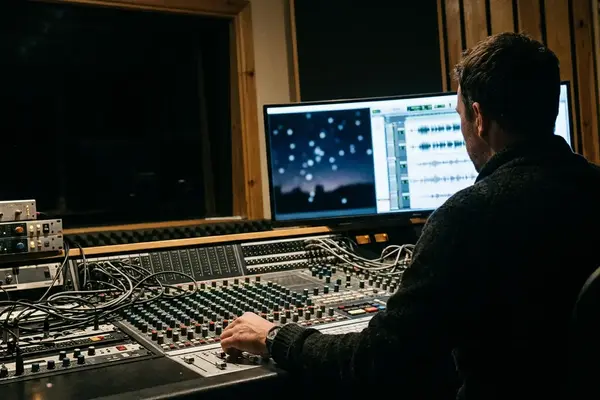
Final morning. Packing. Field recordings on one screen, transmission logs on the other. I am matching takes to photographs of fissures and columns, not hunting the loudest file.
Compare equal-level 40 Hz and 60 Hz passages. Mark microphone positions against the pictures. Separate thermal compression from site response. Review the first and last 30 seconds of each sustained-tone take for level drift that may indicate battery sag, limiter action, or voice-coil heating.
The log keeps separate columns for transmitter level, receiver level, transducer level, source-to-face distance, microphone position, temperature, and barometric pressure. I compare only takes made with identical gain settings. Any deliberate oscillator reduction at the basalt site stays in the notes as a documented artistic and engineering intervention.
Equal-Level Takes
Fractured, soil-filled granite calls for coupling to intact faces and enough power to survive the joints. Basalt calls for holding the chain still and aligning phase so the columns do not smear the drone.
Granite demands power and proximity to solid faces. Basalt requires restraint and careful phase alignment to avoid muddying the transmission. The instruction is conditional. Geology is not a preset.
I close the cases on the last of the kit and leave the two formations in the archive as they measured, not as I wished they would behave.
Will you keep fighting the landscape's natural acoustics on the next broadcast, or will you finally tune the chain so the rock is allowed to speak?