The Human Pulse vs. Geological Time
Musical structures obsessively tie themselves to the human heartbeat. The common resting-heartbeat tempo frames most compositions around 60–100 BPM—an anthropocentric timeframe that dictates how we consume sound. Electronic drone music forces a rupture in this cultural habit. It suspends obvious pulse for 12–45 minutes or longer.
The listening frame shifts away from countable bars and drops. Attention moves to gradual changes: filter drift, beating between close frequencies, amplitude swell, room resonance, and ear fatigue. A useful compositional condition emerges here. Let a harmonic event unfold slowly enough that the listener cannot easily mark the change as a conventional musical section. This aligns perception with the much slower scales of erosion and mineral compression.
The Misunderstanding of 'Passive' Ambience
Drone and ambient music frequently face dismissal as passive background noise or synthetic escapism. This accusation reveals a listening-method problem rather than a compositional flaw. True drone music demands active, uncomfortable, and durational listening.
A sustained sine, bowed tone, or low oscillator can feel static for the first few minutes. After this threshold, the sound becomes physically unstable as the ear starts tracking overtones, room nodes, and pressure differences. In a small untreated room, bass-heavy drones create standing-wave pockets. A tone seems to vanish in one position and thicken a few steps away.
Active drone listening requires removing visual distraction for the full duration of the piece. Sampling a minute or so as a preview guarantees a failure to comprehend the work. Sitting with sustained frequencies mirrors the discomfort and patience required for genuine ecological awareness.
Sonic Biocentrism: De-centering the Listener
The deep ecology movement advocates for biocentric equality, a principle that translates directly into sound art. In this framework, the listener is not the destination of the composition but one organism inside a larger field. Verse/chorus structures commonly promise return, contrast, and reward. Drone environments replace those cues with persistence, density, and spatial relation.
This strips the listener of their narrative centrality. A drone composition acts as an environment. It is often built from two or three sustained frequency sources. Their interaction changes according to loudspeaker placement, outdoor wind, terrain reflection, or battery behavior. The listener’s role becomes observational. They track micro-variation in air, surface, and body rather than following plot-like musical development.
Synthesizers as Earth Materials in Site-Specific Broadcasts
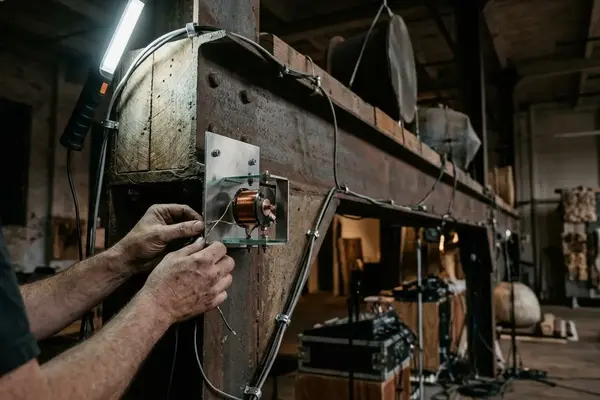
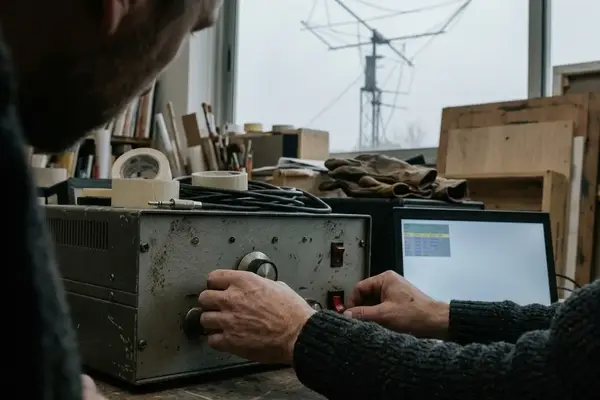
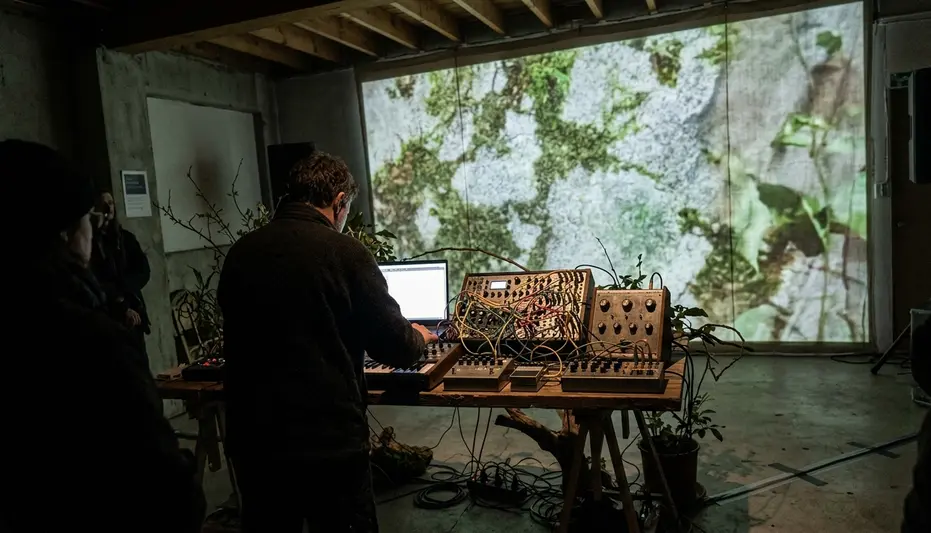
A paradox exists in using highly technological, electronic instruments to connect with the natural world. Yet, electronics are not immaterial. Synthesizer signal paths depend on material components. Copper traces, solder, magnets, silicon, lithium-based batteries, and rare-earth elements form the core of speaker and electronic assemblies. These are fundamentally extracted earth materials.
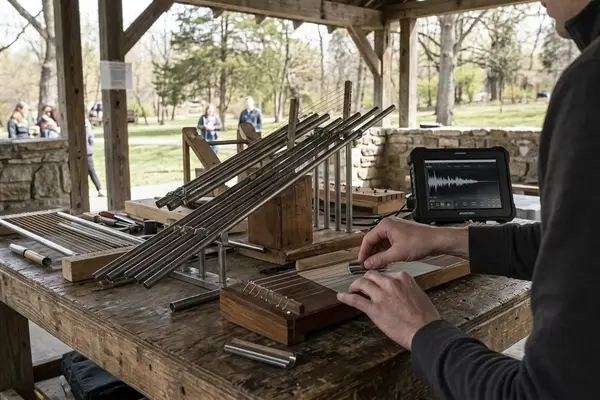
Site-specific radio transmissions return these manipulated earth frequencies back to remote landscapes. A site-specific broadcast can be planned as a 20–40 minute transmission window around dawn, dusk, or another transitional light condition. During these windows, wind, animal movement, and temperature shifts are perceptually pronounced. Operational details dictate the reality of the broadcast. They include portable power, a compact transmitter, weather-safe cabling, a narrow speaker spread, and a listening radius defined by terrain rather than venue architecture.
Field Note: Remote playback conditions change the composition entirely. Fog can dampen high frequencies, rock faces can throw short reflections, and open scrubland can make low tones feel detached from any visible source.
The Boundaries of Acoustic Activism
Critical review reveals the strict limits of sound art as an ecological tool. Drone listening can reshape perception, but it cannot be promoted as ecological repair. A low-impact session still involves travel, batteries, recording equipment, data storage, and replacement electronics. The ecological claim has to include the production chain.
The language of 'eco-ambient' becomes suspect when the release cycle, packaging, touring, or streaming dependency contradicts the stated reverence for slow ecological attention. A responsible project brief should state exactly what is being changed: listening habits, site awareness, audience perception, or actual material footprint. A drone piece marketed as ecological can still function as aesthetic branding if the artist flies equipment into a fragile site, over-amplifies the landscape, and leaves the production footprint unexamined.
Important: Drone music can cultivate ecological attention, but it is not a substitute for habitat protection, emissions reduction, repair work, or changes in resource use.
Tuning Your Practice to the Biosphere
Turning this philosophy into practice requires composing with site, duration, and restraint before choosing timbre. The workflow begins with listening to the place itself.
- Spend 30–90 minutes in the site without recording or performing before placing microphones, speakers, or transmitters.
- Choose one primary environmental variable to respond to: wind direction, water movement, insect density, rock reflection, ground moisture, temperature drop, or human absence.
- Limit the first composition sketch to one long harmonic relationship, one modulation behavior, and one spatial decision instead of building a dense arrangement.
- For a durational piece, test a 15-minute static pass, then a 25–35 minute version with only two audible changes: one spectral shift and one spatial shift.
Context-dependent variation dictates the outcome. A sub-bass drone that feels meditative in a concrete room may become intrusive near nesting habitat, while a nearly inaudible high-frequency transmission may be meaningful only to a small on-site audience. Not every long tone produces deep ecology. The shift depends on duration, attention, site relation, restraint, and whether the listener stops treating the sound as background décor. Approach your next drone experience as an exercise in ecological empathy.