The Thesis: Rejecting the Algorithm for the Atmosphere
The Counter-Argument: Elitism and Technical Futility
The Refutation: The Forest as the Ultimate Collaborator
Curating for the Canopy: A Practical Implementation
The Provocation: Why Play Music for Trees?
The empty receiver is the point
Months of private listening can end in a clearing where no one is standing.
That sounds absurd until the work is understood as a pressure test for intention. A 24-hour transmission of unreleased electronic audio, sent through low-power FM into a remote forest, refuses the usual bargain: listen now, save later, share instantly, count everything. The forest offers no applause. It does not add the piece to a queue. It does not clip the best minute for a feed.
For a curator, that absence is not a stunt. It is a hard condition. If the work cannot be counted, replayed, recommended, or converted into archive matter, then the curatorial act has to stand on different legs.
Against the habit of permanent availability
Most recorded music now travels with a shadow ledger. Plays, completions, skips, playlist positions, saves: every gesture becomes evidence of reach. The industry has trained artists to think of circulation as proof of value, and it has trained listeners to expect every sound to remain available somewhere, ready to be summoned again.
A forest broadcast interrupts that contract. The project centers on continuous transmission, not later upload. It asks for roughly six to ten weeks of track solicitation and private auditioning before the sequence is locked, then lets the whole thing pass into the night air. The care is real; the evidence is thin.
That thinness matters. It returns risk to a medium that has become too easy to preserve. The act is not anti-listener. It is anti-capture.
Field Note: The broadcast site should be visited at least once before dawn and once after dusk. The acoustic floor of a forest is not stable; birds, insects, wind through leaves, and temperature shifts can make the same clearing feel like two different rooms.
The Thesis: Rejecting the Algorithm for the Atmosphere
Curation by air, not by compatibility
Site-specific radio transmission is a radical refusal of commodified listening because it removes the track from the marketplace of easy comparison. The question is no longer whether a piece sits neatly beside another item in a playlist. The question is whether it survives contact with moss, slope, wet bark, distance, and a receiver held in a cold hand.
That changes how the sequence is built. Texture comes first. Spatial depth matters. Long decays, unstable stereo fields, low-mid pressure, brittle high-frequency dust, and slow harmonic movement become more important than a clean drop or a fast opening hook. Some pieces announce themselves beautifully in a studio and become brittle outdoors. Others barely move indoors but bloom when the air gives them room.
The curator listens for behaviour rather than polish.
The edition is the transmission
Unreleased and unarchived material alters the listening contract. The transmission is not a preview of a later catalog object. It is the edition. When the signal ends, the public form of the work ends with it.
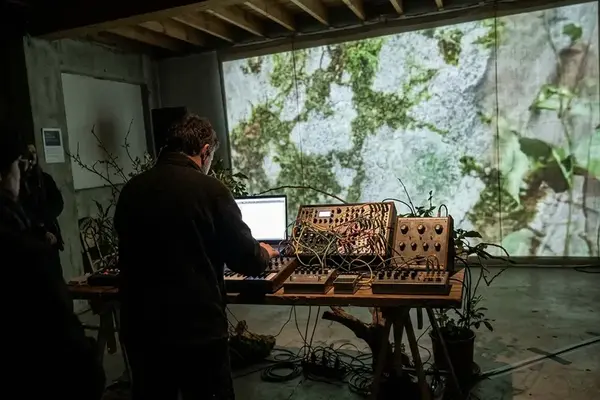
That decision restores a kind of aura to electronic music without pretending that scarcity alone makes something meaningful. The mystery comes from context. A producer who sends a quiet granular piece into a forest accepts that leaf-noise may swallow its edges. A modular system recorded with enormous studio width may collapse through FM into something narrower, stranger, more spectral.
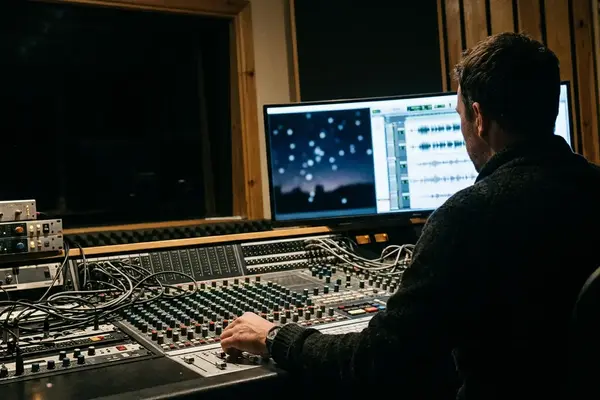
Iterations demonstrate a practical rule: audition the sequence on small battery speakers, open-back headphones, and a mono receiver before trusting it. Studio monitors flatter detail. Outdoor playback exposes weak middles, awkward silences, and stereo tricks that vanish under FM collapse.
Check tracks with abrupt sub-bass surges at low volume before inclusion.
Listen for sounds that hold shape after the stereo image narrows.
Prioritise pieces that leave space for wind, branch movement, and distant animal activity.
Treat hiss and partial masking as possible collaborators, not automatic defects.
The Counter-Argument: Elitism and Technical Futility
The criticism has teeth
A private broadcast into an unpeopled landscape can look precious. If artists refuse documentation while still asking for cultural attention, the gesture risks becoming mystification in a waterproof coat. The listener may wonder who the work is for, and whether absence has been dressed up as depth.
That suspicion should not be brushed aside. A project that hides the sound, withholds the archive, and speaks only in foggy language deserves scrutiny. The strongest version of the criticism is simple: broadcasting to an empty forest is exclusionary, technically fragile, and almost impossible to evaluate.
Critical review reveals the uncomfortable part: conventional success measures do not work here. There may be no audience survey, no visible crowd, no streaming trail, no replay figure. Even when a handful of people make the pilgrimage with receivers, their experience depends on where they stand, how they tune, how fast they walk, and what the weather is doing at that moment.
FM does not behave politely in woods
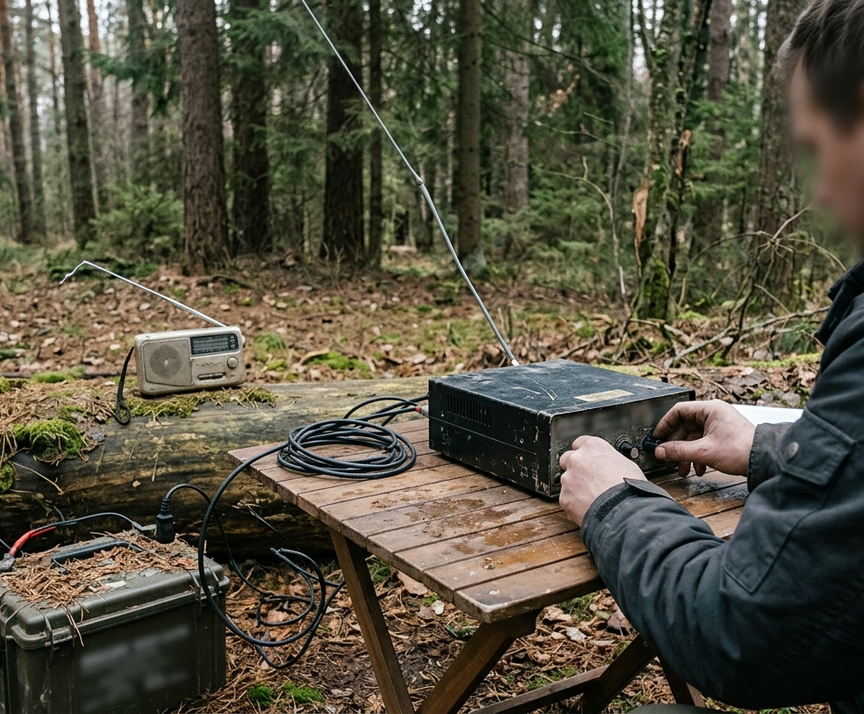
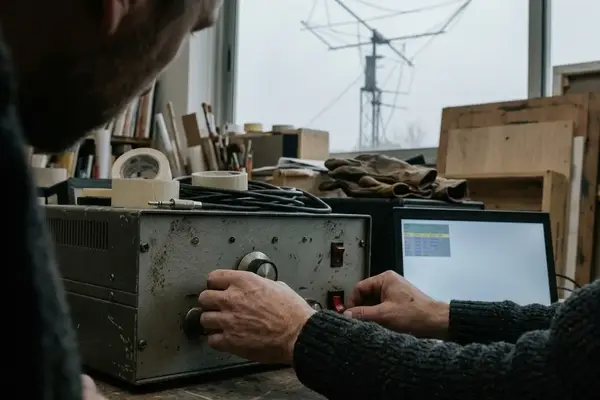
The technical limits are not romantic decoration. Low-power FM transmission is highly sensitive to antenna height, battery stability, and line-of-sight obstruction. A transmitter that sounds clean in an open field can become ragged behind wet trunks and uneven ground.
Dense foliage can create audible flutter, hiss, and partial masking, especially when the receiver moves by hand through understory instead of staying in a fixed clearing. Rain, fog, and canopy moisture can alter both the RF path and the perceived acoustic blend, so weather checks should happen within a day or so of transmission.
Important: This argument has less force if the site is treated merely as a hidden speaker location; the premise depends on letting terrain, weather, and signal failure visibly alter the work.
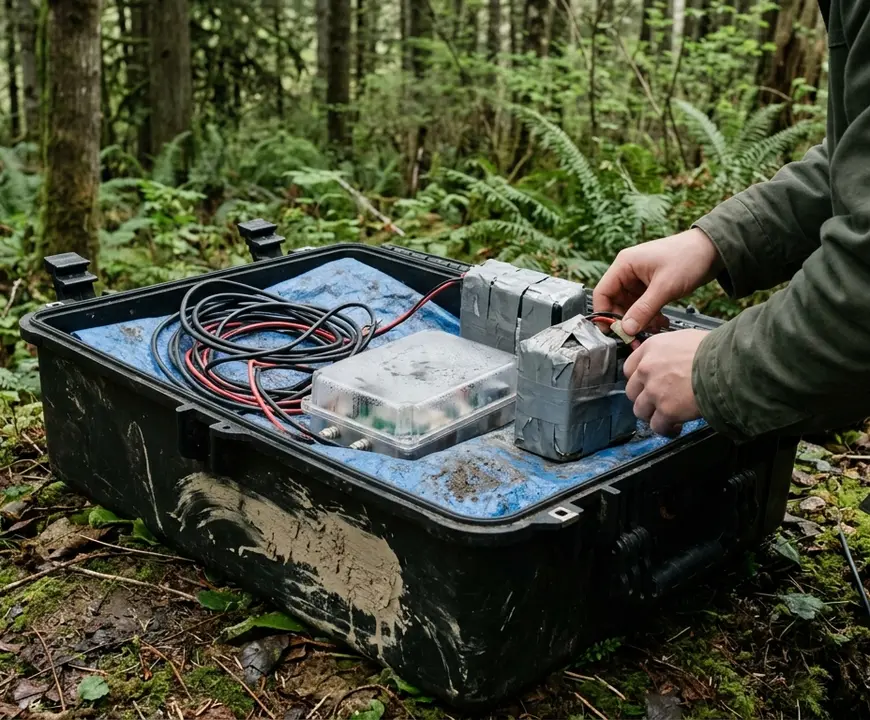
Technical futility becomes a fair charge when the setup pretends the forest is neutral. It is not. The canopy absorbs, scatters, and confuses. The ground rises and drops. Batteries sag. Condensation creeps into cases. The work has to be planned for those frictions, not rescued from them.
The Refutation: The Forest as the Ultimate Collaborator
The receiver is not only human
The refutation begins by moving the listener off centre.
The forest is not scenery around the broadcast. It is the active filter through which the piece becomes itself. Topography, humidity, tree density, and ground slope do not simply damage the signal; they shape it. The same transmission can feel clean at the edge of a ride, smeared under birch, intimate in a hollow, and almost gone behind a wet bank.
Context-dependent variation is not a minor concern. A dry pine stand, a wet deciduous ravine, and a mossy upland clearing will not receive the same broadcast in the same way. Antenna height, canopy moisture, and ground slope can matter more than the nominal power of the transmitter.
That is where the work touches acoustic ecology: not as a slogan, but as a practice of listening to how human-made frequencies interact with a living acoustic field.
Signal failure as compositional material
A failure case worth preserving: the most carefully mastered track may become a thin ribbon of hiss if its energy sits above the forest wind and leaf-noise band, while a less polished low-mid drone may carry beautifully through trunks.
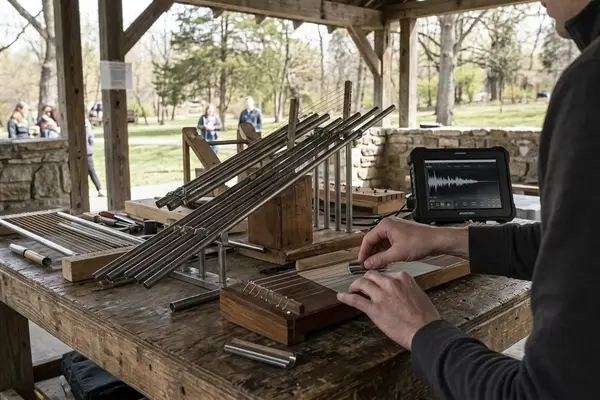
This is not an argument for sloppy production. It is an argument for site-responsive judgment. Receiver walks should be logged at fixed intervals, such as every 25 to 50 meters, not to optimize reach alone, but to locate where the broadcast becomes porous, smeared, or unexpectedly intimate.
A simple field log is enough. Note time, weather, receiver position, perceived noise floor, and audible interference. Do not reduce the project to a binary successful or failed transmission. The useful evidence is often stranger than that: a pulse that disappears near bracken, a high tone that returns in a clearing, a drone that seems to thicken as dusk closes around the canopy.
Dawn programming benefits from lower-density material because bird calls and temperature shifts already occupy the foreground. Dusk can tolerate thicker modular movement as the canopy darkens and the acoustic field compresses. The forest is not passive at either edge of the day. It edits.
Curating for the Canopy: A Practical Implementation
Build the day by light, not genre
A 24-hour site-specific broadcast should be sequenced like a slow environmental score, not like a concert with invisible seating.
Start by dividing the day according to local light conditions: pre-dawn, morning activity, high daylight, late afternoon, dusk, early night, deep night, and the return toward dawn. A workable plan uses seven to nine program blocks across the full cycle, with transitions aligned to changes in the site rather than symmetrical clock hours.
Pre-dawn can carry sparse drones, quiet granular material, or near-static tones. These sounds leave room for the forest to wake around them. Morning can hold more porous rhythmic detail, though anything too crisp may fight birdsong and leaf movement. High daylight often benefits from patient midrange work, especially if wind lifts and masks delicate upper frequencies.
Dusk is different. Dense synthesis, unstable pulses, and wider-band textures can sit there because the site itself becomes acoustically thicker. As visibility drops, the ear accepts more pressure. Night does not need to be louder, but it can be heavier.
Test the weak points before the ritual begins
Map the listening area. Walk the likely receiver routes before committing to antenna placement. Mark spots where the signal thins, folds, or becomes unexpectedly clear.
Run a test loop of roughly an hour. Include the quietest passage, the loudest passage, and one dense midrange section. This exposes battery sag, antenna placement problems, and unwanted distortion.
Match frequency weight to woodland density. In thicker woods, brittle highs may vanish into leaf noise while low-mid material can travel with more body. In open clearings, narrow high tones may become exposed and severe.
Prepare for handling failure. Keep a sealed backup playback device, spare power cabling, and a printed running order on site. Condensation and cold fingers make screen-based troubleshooting unreliable.
Leave room in the sequence. Silence, near-silence, and slow fades allow the site to enter the work without being treated as background ambience.
The practical aim is not maximum range at all costs. Range matters, but aesthetic impact matters too. A clear signal that ignores the site can feel blunt. A slightly unstable signal, moving through wet branches and uneven ground, may tell the truth of the location more precisely.
Bottom Line: Curating for the canopy means choosing sounds that can be altered without being destroyed. The forest is not the venue after the work is finished. It is part of the instrument.