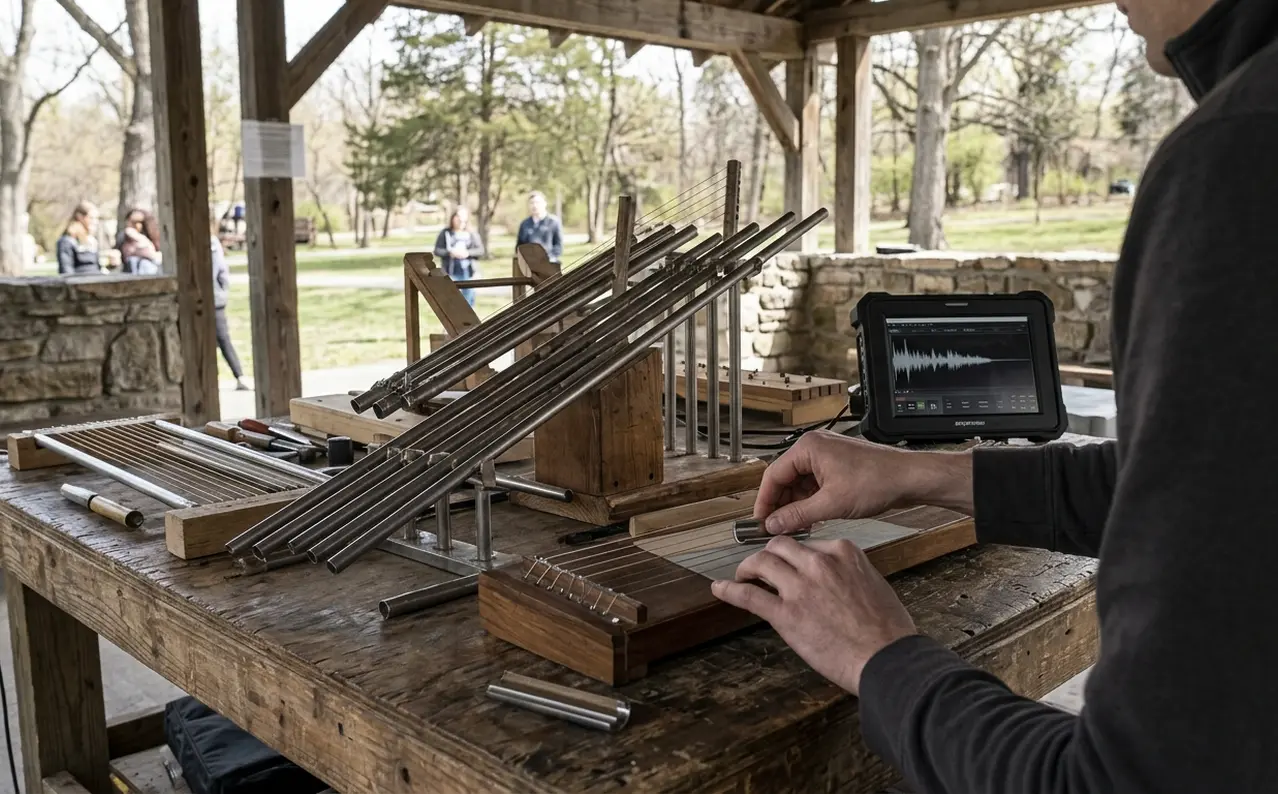
Microtonal composition begins with exact relationships: oscillator ratios, beating pairs, narrow deviations measured in cents. Open air unsettles that precision. Between loudspeaker and listener, a signal crosses moving air, uneven ground, vegetation and shifting thermal layers. Each path edits the balance of frequencies before the ear assembles them into pitch.
The useful question is therefore physical as much as musical: How does a remote landscape rewrite a microtonal composition before it reaches the listener? The answer changes how a piece should be tuned, tested and finally released into the dark outside.
The Environmental Pitch Shift
Oscillator Pitch and Received Pitch
A stable oscillator can preserve a microtonal interval perfectly at the source. The listener receives something less tidy: direct sound combined with ground reflections, terrain screening and frequency-dependent losses. That mixture can alter the apparent strength of an interval even when its underlying frequencies remain fixed.
At 20 degrees Celsius, sound travels at roughly 343 metres per second. A listener standing 300 metres from a loudspeaker hears the direct signal about 0.87 seconds after emission. During that journey, the programme has entered a layered acoustic field rather than an enlarged version of the studio.
Consider a 10-cent interval above 1,000 hertz. Its upper tone falls near 1,005.8 hertz. The separation is narrow enough that small changes in harmonic balance can make it feel pronounced, fragile or absent. The oscillators have stayed in tune; the perceptual evidence has changed.
The Site Enters the Score
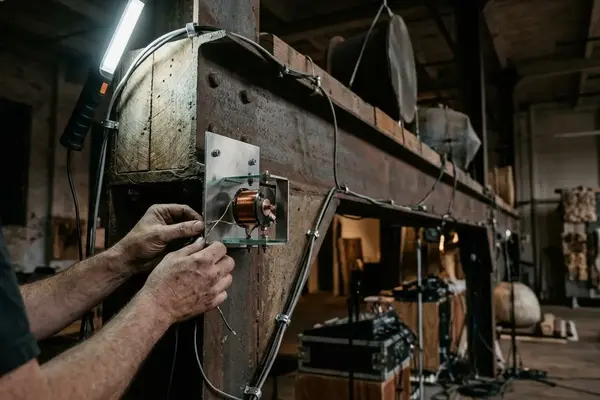
Remote landscapes behave as active components of sound art & experimental practice. A slope redirects energy. Soft ground absorbs and reflects differently from a hard track. Foliage interrupts short wavelengths, while exposed terrain leaves the signal vulnerable to wind. These elements create several versions of the same transmission along a single listening route.
A narrow interval that beats clearly at 50 metres can disappear at 200 metres when its upper partials fall beneath wind, insects or moving foliage, even though the transmitter remains perfectly tuned. That disappearance belongs to the work. It marks the point where numerical pitch meets environmental audibility.
Field Principle: Tune the source precisely, then judge the composition from the site’s listening positions rather than from the equipment rack.
Atmospheric Modulation of Sound Waves
Air Is a Layered Medium
Assigning one temperature to an outdoor site conceals the mechanism doing much of the acoustic work. Air near the ground may differ from air several metres above it. Those layers carry sound at different speeds, bending propagation paths upward or downward as conditions change.
A useful approximation is c = 331.3 + 0.606T metres per second, where T is the air temperature in degrees Celsius. A 10-degree temperature difference changes local sound speed by about 6.1 metres per second. Across a long transmission path, that variation affects arrival time, refraction and the relationship between direct and reflected components.
Humidity contributes another frequency-selective layer. Over distance, atmospheric absorption reshapes upper harmonics more readily than low foundations. The practical result resembles a mobile low-pass filter whose action changes with the air mass and the route through it. A complex microtonal tone may arrive with fewer cues than its studio version, leaving the fundamental pair exposed or perceptually weakened.
Wind, Phase and Time
Wind shear creates different propagation speeds at different heights. It bends wavefronts, shifts phase relationships and can produce slight Doppler-like fluctuations as moving air changes the transmission path. With already close frequencies, those small disturbances can animate the beating or blur it into irregular motion.
The same evening transmission may sound darker downwind and unexpectedly brighter across a sheltered slope because refraction, terrain screening, ground impedance and loudspeaker directivity interact differently along each path.
Dawn and dusk deserve structured listening sessions. Run comparison captures across the 45 minutes either side of sunrise, then repeat the same window around sunset, keeping source level, loudspeaker orientation and programme material unchanged. Measure temperature at loudspeaker height and again several metres above it. The comparison reveals how the atmosphere develops through time instead of reducing the site to one reading.
Psychoacoustic Perception in Unbounded Spaces
What the Walls Usually Supply
Indoor listening wraps a tone in early reflections and reverberant decay. In open air, those dense room cues fall away. The ear receives a more exposed direct signal, intermittent ground reflection and whatever the terrain sends back. Dissonance can feel dry and sharply etched near the source, then lose definition farther along the route.
Microtonal pairs should be auditioned sequentially and simultaneously. Sequential presentation tests melodic pitch identity. Sustained pairs reveal beating, roughness and level imbalance. The distinction matters because a pair that reads clearly as two successive pitches may fuse into one unstable colour when sounded together.
Two sine tones at 1,000 and 1,006 hertz produce a six-beat-per-second amplitude fluctuation when they arrive at comparable levels. That final condition is crucial outdoors. Directionality, scattering or a slight change of position can reduce one tone and soften the beat without changing either frequency.
Critical Bands Without a Room
Using the equivalent rectangular bandwidth approximation, auditory-filter width near 1,000 hertz is about 132 hertz. Many microtonal pairs therefore occupy the same auditory filter, although listeners may still distinguish their beating. Open-air transmission changes the balance feeding that filter: fewer stable reflections, more path-dependent level differences and a noise floor shaped by the site itself.
Human judgments of pitch drift and roughness remain highly position-dependent. Moving the listener, turning the head or altering the direct-to-ground-reflected path can reverse an impression recorded only metres away. This places a firm limit on claims about what an outdoor microtonal piece “sounds like.” A single microphone position documents one encounter, not the whole acoustic field.
Listening Test: Ask listeners to report pitch separation, beating and roughness independently. Those three impressions often change at different points along the route.
Structuring Compositions for Outdoor Transmission
Build a Sparse Transmission Skeleton
Outdoor arrangements benefit from exposed architecture. Start with a low anchor, add one or two interval pairs, then introduce controlled harmonic accents. This structure leaves enough spectral space for the atmosphere to alter a layer without turning the entire piece into auditory mud.
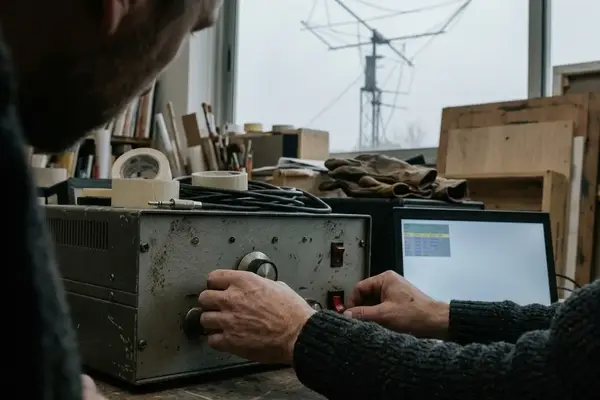
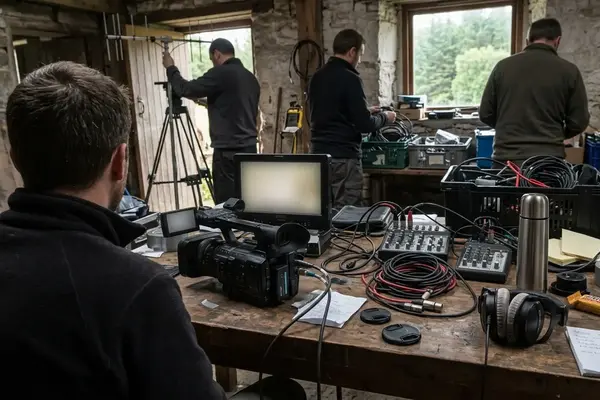
Use repeatable monitoring points such as 5, 50 and 200 metres from the source. Place microphones at approximately ear height and play the same 60- to 90-second test passage at every position. Keep source gain and orientation fixed. The aim is a comparable set of field passes, not a collection of attractive fragments.

- Test the anchor alone. Confirm that it establishes continuity at near, middle and far positions.
- Add one interval pair. Listen sequentially for pitch identity, then sustain it to expose beating.
- Introduce upper partials carefully. Remove any harmonic layer that masks the interval at the middle position.
- Walk across the axis. Loudspeaker directivity can transform high microtones more abruptly than a straight distance test suggests.
- Repeat under a contrasting atmospheric window. Preserve the passage and settings so the comparison remains useful.
Choose Waveforms by Distance
Sine tones offer clean interval tests because their beating can be heard without a dense harmonic stack. Complex sawtooth-like material supplies more pitch cues, yet its upper harmonics face stronger losses and scattering over long, humid paths. Once those harmonics thin out, the distant timbre may bear little resemblance to the close reference.
Wavelength explains part of the split. At roughly 343 metres per second, a 100-hertz wave is about 3.43 metres long, while its 5,000-hertz counterpart measures something like 6.9 centimetres. The shorter wave is more vulnerable to directional loudspeaker behaviour, foliage scattering and small positional changes.
Low frequencies can therefore anchor a site-specific broadcast in many directions. High microtones scatter, fade or brighten along particular paths. Composition should assign different jobs to them: lows hold the ground; exposed highs articulate local events. For radio transmissions and other special projects, this division also helps the piece survive beyond the most favourable listening point.
Surrendering Control to the Landscape
Weather as the Final Mastering Chain
A pristine close-range reference is a poor master for rugged terrain. Preserve oscillator ratios, then let the installation score define weather states, listening routes and acceptable transformations. The score can identify where beating should remain legible, where spectral erosion is welcome and where disappearance forms part of the composition.
Archive each field pass with source gain, microphone position, temperature at source height, wind direction and a continuous 10- to 15-minute recording of the transmitted sequence. These broadcast archives become practical maps of behaviour. They show how a work inhabits a site across time, rather than freezing it into one supposedly authoritative capture.
Before opening the installation, compare at least three listening positions during two contrasting 90-minute atmospheric windows. Walk the route while the sequence repeats. Listen for the points where intervals sharpen, merge, lose their beating or return as altered timbres.
Stop mastering outdoor microtonal work toward studio purity. Compose the distortion into the piece, document its boundaries, and give weather the final pass.