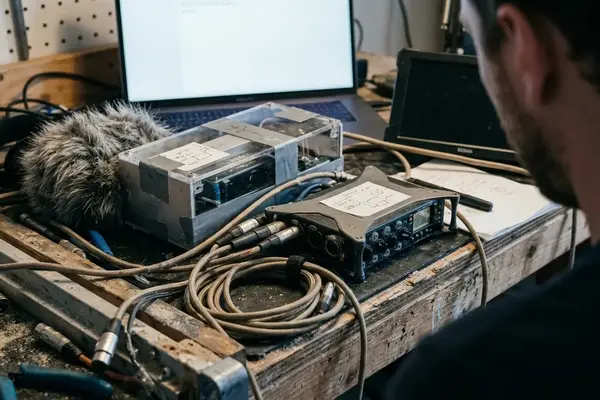
Rigging the Receiver Before Nightfall
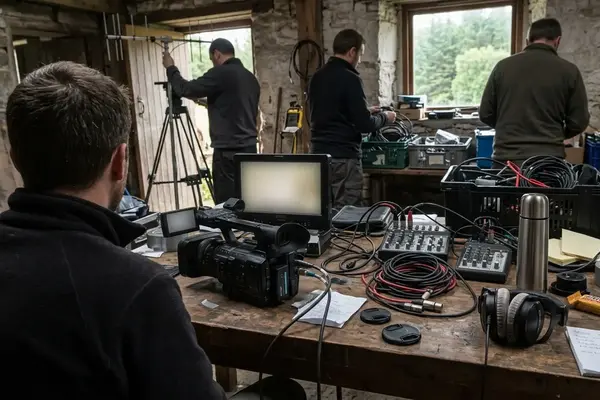
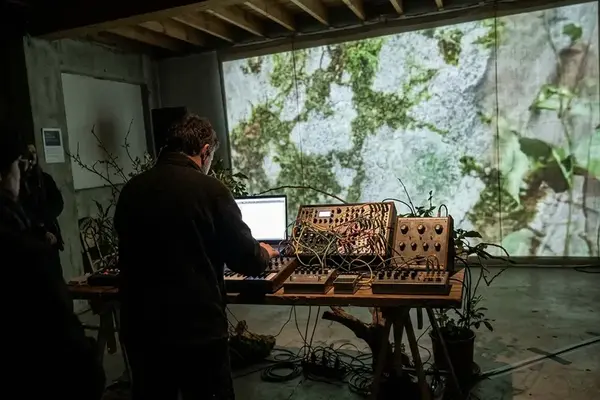
The physical act of rigging a modular synthesizer in a remote woodland demands a specific temporal discipline. The rig requires positioning before dusk so gain staging can be completed while cables and branch attachments remain visible. Allow something like 20 to 35 minutes before sunset for microphone placement, cable inspection, and preamp adjustment. The forest already broadcasts. A synthesizer simply acts as the receiver. Making electronics listen is the hard part.
Shadows lengthen across the damp soil, obscuring the intricate network of roots and fallen timber. Securing contact microphones to bark requires precision that disappears with the light. The transition from day to night alters the acoustic properties of the woodland. Temperature drops shift the humidity, changing how sound travels through the dense canopy. Electronic instruments sit dormant, waiting to be integrated into this existing ecosystem. The goal is a symbiotic relationship between the silicon circuits and the organic environment.
Rather than beginning with an oscillator sequence, the setup begins by monitoring the forest microphone alone. Leaf friction occupies the bright foreground. Trunks carry dull impacts. The approaching night raises intermittent insect bands. Record a three to five-minute reference take with the synthesizer muted. Use this silent monitoring pass to identify persistent beds, isolated gusts, and handling noise before opening any modulation route.
Abandoning the Grid for the Ambient Floor
Early trials often rely on a fixed clock and repeating note pattern. Those regular accents continue unchanged through calm air, gusts, and bird calls. This renders the woodland sound a mere decoration behind a studio patch. That approach fails in unpredictable outdoor environments. The ambient floor must become the primary modulation source.
Rigid electronic clocks clash with erratic natural rhythms. The forest breathes in unpredictable cycles—a rhythm that defies rigid sequencing. Forcing a rigid tempo onto this terrain creates a jarring disconnect. The synthesizer must yield control to the environment. Wind dictates the pacing. Rustling leaves trigger the events. A continuous, fluctuating voltage from the ambient noise floor breathes life into the patch.
Ambient Calibration ProtocolCapture 60 to 90 seconds of the quietest available ambience. Set the detector threshold just above the resulting idle envelope rather than calibrating against absolute silence.
Use a detector release in the 1.5 to 4-second range as a starting point. Shorter releases tend to reproduce every twig impact as an abrupt control-voltage drop. The ambient floor is amplified, filtered, and converted into a slowly varying control signal.
Isolating Usable Control Voltage from the Wind
Spectrum analysis serves as a routing aid. Forests lack fixed frequency bands. A high-pass path requires adjustment until microphone buffeting stops dominating the envelope. For an air microphone, test a high-pass corner between 70 and 140 Hz to reduce wind rumble. Audition a 2 to 7 kHz band for leaf hiss and small branch friction.
Place a foam windshield beneath an outer furry shield and keep the capsule out of direct gusts. Observe the envelope output for two to three minutes at each gain setting before changing the threshold. The preamp is set while listening to both its audio output and watching the resulting voltage. Tracking environmental audio depends heavily on preamp quality and wind shielding, though this approach assumes a high-impedance input stage.
Understanding baseline acoustic environments helps isolate usable frequencies to generate stable control voltage. Low-frequency rumble from distant wind can easily overwhelm a sensitive envelope follower. Filtering out these unwanted frequencies ensures the synthesizer responds only to the desired acoustic events. The rustle of dry leaves provides a sharp, transient-rich signal ideal for triggering envelopes. A creaking heavy branch offers a slow, evolving modulation source.
Shaping the Generative Breath
The control network builds in layers. A fast envelope preserves the onset of a gust. A slew limiter then stretches its uneven contour into a phrase-scale swell. Begin with roughly 100 to 300 milliseconds of rise slew and 2 to 6 seconds of fall slew. Lengthen the fall until gaps between nearby gusts join into one audible breath.
One copy opens the drone VCA. Another is attenuated before reaching the filter cutoff, preventing the same gust from driving every parameter through its full range. A sample-and-hold captures selected environmental voltage changes. The generative system must breathe with the forest. Erratic wind data transforms into musical swells. The synthesizer becomes an extension of the landscape.
Route environmental CV through quantizers to maintain harmonic cohesion with the natural drone. Limit quantized material to three to five pitch classes. Attenuate the incoming control voltage before quantization so ordinary wind variation spans roughly one octave rather than the module's entire pitch range. Field notes from earlier sessions back this up: a narrow palette holds together where a wide one scatters.
Managing Current Draw and Damp Soil
Power planning starts from the measured current draw of the assembled case rather than the printed capacity of the battery. Positive and negative rail loads convert to watts. A case drawing 0.85 A from +12 V and 0.35 A from -12 V consumes just about 14.4 W on those rails before accounting for the 5 V rail and conversion losses. Calculate each actual case from its measured rail currents.
Add converter overhead and size the battery with reserve for falling temperature. Log battery voltage and case behavior every 30 to 45 minutes during the first field run. Keep connectors off damp soil. Raise the case from the ground on a rigid platform. Allow a cold enclosure 30 to 60 minutes to acclimate before opening it indoors.
Operating equipment on damp soil presents significant grounding issues. Humidity threatens sensitive Eurorack modules. Extended site-specific installations require meticulous battery management strategies. The physical reality of the woodland demands careful preparation. Damp earth conducts electricity, creating potential ground loops and unwanted noise. Protecting the gear ensures the installation survives the night.
The Branch-to-Envelope Architecture
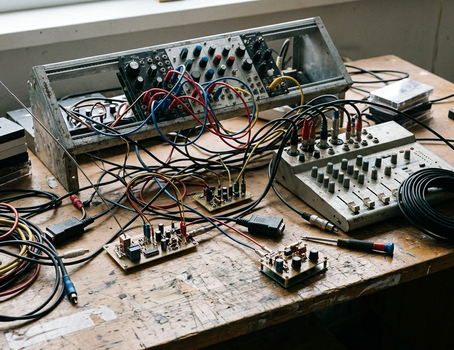
Clamp or tape a contact microphone to a flexible branch. Route this into a high-impedance preamp. Mult the preamp output. Send one branch to headphones or a recorder for diagnosis. Send the other into an envelope follower.
Pass the follower's control output through an attenuator and slew limiter before reaching the control input of a VCA carrying a low-frequency drone. Route the drone oscillator into the VCA audio input, and send the output to a recorder or low-level monitor. The branch-to-envelope split provides diagnostic audio on one mult output and gust-derived control voltage on the other.
Observe two to four naturally occurring gusts before fixing the threshold. The still-air threshold boundary ensures trunk tremor stays silent while the next branch-bending gust opens the drone. A single run makes the whole architecture legible: a birch limb wired at dusk, threshold set just above the tremor of still air, slew fall stretched to four seconds, then a 10 to 15-minute unattended recording left to run. Played back, the drone holds silent through the small stuff, swells twice where the wind crossed the clearing, and reveals one false trigger where the cable brushed bark—which is exactly what the tape is for.