Broadcasting Into the Void
What happens when you broadcast avant-garde electronic music to an audience of trees, rocks, and wind?
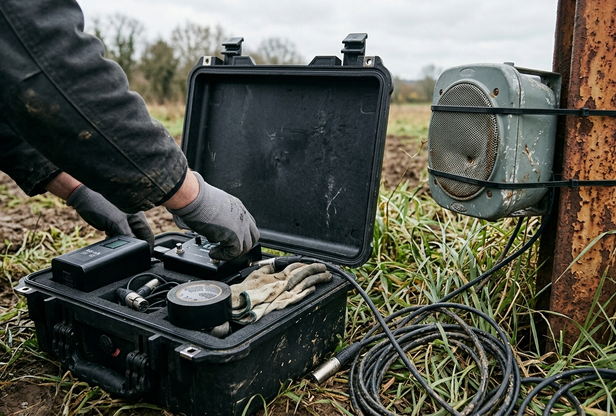
At dusk, the question stops sounding theatrical. Stand beside the speaker and the work feels almost manageable: oscillator, amplifier, battery, enclosure, the familiar small rituals of signal chain and gain. Walk 30 to 100 meters away and certainty starts to leak out. Bracken cuts the high end. A fold in the ground delays the bass. Rising wind edits the mix without permission.
This is where site-specific sound art becomes interesting. Not because the landscape decorates the work, but because it argues with it. The hill refuses balance. Trees absorb detail. Stone sends back a version of the piece that the artist did not write.
Gallery sound is often built around control: clean power, predictable walls, sealed doors, obedient darkness. Remote sound practice asks for another discipline. The installation has to hold its shape while the weather moves through it, while listeners drift off-route, while the site reveals its own timing.
The best outdoor works do not conquer that instability. They make a pact with it.
Field Note: Listen twice before installing anything: once beside the intended source, and once from the place where the work starts becoming strange. That second position usually tells the truth.
Criteria for Selection & Acoustic Limitations
These five techniques are chosen for field practicality, not studio elegance. Each one can survive a carry-in setup, battery operation, minor weather exposure, and uneven terrain while still leaving room for rigorous artistic decisions.
That test matters. A concept that needs a silent room, mains power, polished floors, and a technician hidden behind a curtain is not ready for a hillside. Remote work rewards systems that are simple enough to carry and precise enough to withstand scrutiny.
Before committing to a site, run a 45–90 minute dry deployment with the actual power source, cables, enclosures, and playback chain. Do not test a fantasy version of the installation. Test the awkward one: the battery that must last, the cable that crosses wet ground, the enclosure that might face sideways rain, the receiver that has to work while someone is walking.
- Practicality: The technique must work with portable equipment, limited crew, and uneven access.
- Weather resilience: It must tolerate minor exposure, shifting wind, temperature changes, and ground moisture without collapsing immediately.
- Artistic rigor: The landscape response must shape the work, not merely provide atmosphere.
- Recoverability: Every object placed on site must be retrievable in fading light, bad weather, or tired conditions.
Log wind direction, temperature shift, ground moisture, and audible human intrusion at the start, midpoint, and end of the test rather than relying on one arrival impression. A site can seem abandoned on arrival and reveal a road, farm generator, dog walker route, or aircraft path forty minutes later.
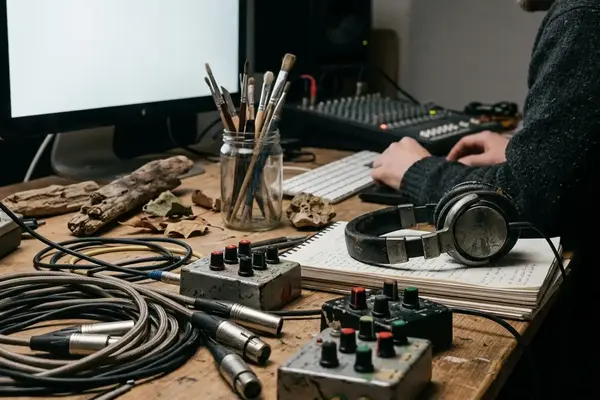
Power is the dull problem that decides whether the work exists. Budget it in watt-hours and include the whole chain: playback device, interface or mixer, amplifier, sensors, transmitter if used, and any data logger. The weakest calculation is usually the one that counts only the loudspeakers.
Acoustic ecology gives this practice its sharper frame: sound is not an object dropped into empty space, but part of a living field of signals, masking, habitat, memory, and attention. Critical review reveals that acoustic ecology and environmental soundscapes remain useful not because they make the work polite, but because they force the artist to hear consequence.
Important: Remote sound work still depends on access permission, fire risk, wildlife disturbance rules, and local radio regulations; the artistic frame does not override those constraints.
Working With the Environment: Topography and Weather
1. Acoustic Mapping and Topographical Reflection
Walk the site before the site is asked to perform.
That sounds obvious, but many weak installations begin with a speaker position chosen for convenience: near the path, near the gear, near the point where the crew first put down their bags. Acoustic mapping starts with slower questions. Where does sound return? Where does it vanish? Which direction feels open but listens badly?
Use clap tests, short sine sweeps, and quiet listening. Natural rock faces can behave like rough delay lines. Dense forests can become soft, uneven filters. A low wall, dry-stone boundary, or ravine lip may do more to shape the work than any plug-in in the playback chain.
Map the site from 5–7 listening points, including one behind the intended source, because rear reflections can become more interesting than the forward projection. In practice, the rear position often exposes the hidden structure of the place: a stone return, a hollowed bank, a corridor of trunks that throws sound sideways.
A ravine that produces beautiful echo at sunset can become unusable when crosswind turns every exposed microphone grille and speaker cone into broadband hiss. Dense conifer stands often swallow high-frequency detail, while bare rock bowls can exaggerate midrange reflections until a delicate drone becomes harsh.
The technique is not simply to find the “best” sound. It is to understand the site’s bias and compose with that bias left intact.
2. Weather-Reactive Generative Systems
Weather-reactive work becomes convincing when the change feels environmental before it feels computational.
A small sensor rig can read wind or humidity and send those values into a synthesizer, sampler, or generative patch. The trick is restraint. Raw weather data can sound like nervous glitching outdoors, especially when wind values jump. Use slow sensor smoothing windows of 30–120 seconds for wind or humidity data when controlling drones, filters, or oscillator beating.
Wind speed can widen the harmonic spectrum. Humidity or ground moisture can shift beating rates. The audible change should arrive gradually enough that listeners notice the landscape changing before they notice the software.
A useful performance window is late afternoon through civil twilight, when temperature gradients and wind changes are often audible without requiring an overnight unattended rig. The light thins, the ground cools, insects or distant human noise may alter the bed, and the drone starts to feel less like playback and more like weather translated into pressure.
One successful pattern for a weather-reactive drone installation places the listener in a shallow clearing, with the source kept plain and the modulation tied to conditions moving through the site. When the wind rises, the tone opens. As moisture gathers, the beating tightens. Nothing announces itself as clever. The field changes, and the work inhales with it.
Immersion and Transmission: Concealment and Radio
3. Concealed Multi-Channel Spatialization
Concealment should come after listening, not before it.
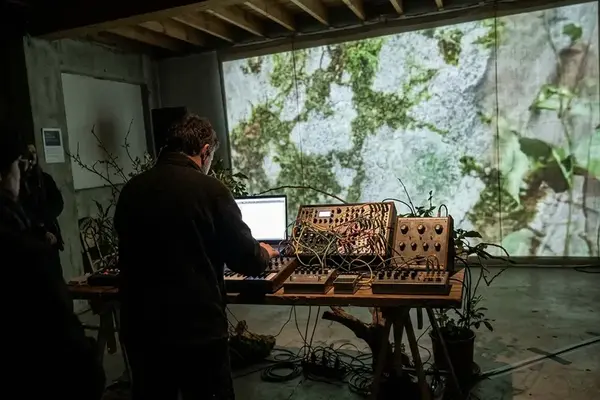
Test the speakers openly first. Place them where they make strong phantom images, where the listener cannot immediately solve the geometry, where a tone seems to hover between trunks or arrive from a hollow rather than a box. Only then should housings, camouflage, and cable routes enter the discussion.
- Set up the system visibly and play the core material at working level.
- Walk the audience route slowly, marking positions where the image detaches from the hardware.
- Shift individual channels by small distances rather than redesigning the whole map.
- Place ruggedized speakers or weather-shielded transducers 20–60 centimeters above ground where possible.
- Hide only after the spatial field works in the open.
Ground contact can thicken bass, but it also muddies detail in wet soil or leaf litter. Raising a transducer slightly often restores articulation without making the source visually obvious.
Keep cable paths short, strain-relieved, and visually dull. Bright tape, neat right angles, and fresh scuffs in moss all betray the hand of the installer. Mark retrieval points with removable non-reflective tags that are visible to crew but not to the audience.
The goal is not trickery. It is to remove the easy visual answer so listening has to search.
4. Low-Power FM Micro-Broadcasting
Radio changes the artwork from a placed object into a moving threshold. The listener carries the receiver. The site becomes a tuner.
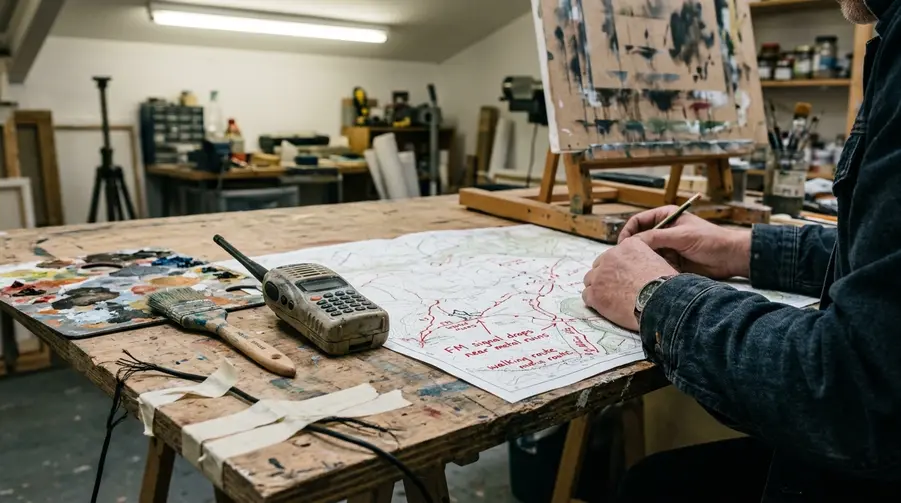
Low-power FM micro-broadcasting suits remote terrain because it lets the audience explore pockets of reception instead of gathering around a visible loudspeaker. A track can thin behind wet foliage, sharpen near a ridge, or disappear beside metal ruins. The transmission is local, fragile, and physically felt through walking.
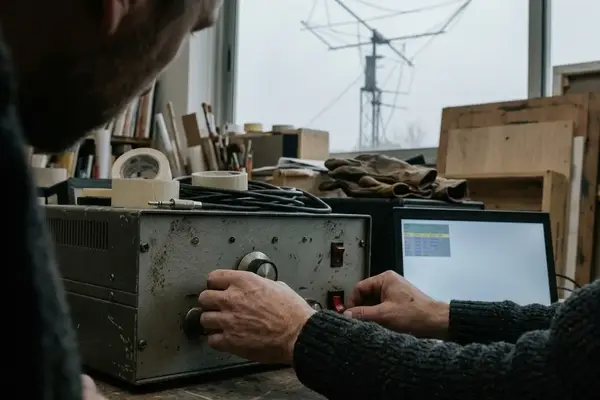
Before any FM transmission, scan the band on site for 10–15 minutes with a portable receiver and avoid occupied or unstable channels. Do this where the work will happen, not from a car park or studio desk. FM micro-broadcasting may feel poetic in remote terrain, but a clean channel during setup can become occupied later by distant propagation or passing vehicles with stronger receivers.
For legal low-power transmission, document the transmitter output setting, antenna length, antenna height, operating frequency, start-stop time, and the rule category or license condition being used in that jurisdiction. This record is not glamorous, but it keeps the work grounded. It also helps the crew repeat, adapt, or shut down the system without guesswork.
Handheld receivers should be tested while walking the actual route, not just beside the transmitter, because ridges, wet foliage, and metal ruins can create reception pockets only a few steps wide. Audience engagement often shows listeners slowing down when the signal becomes unstable; they begin to read the terrain as an instrument rather than a path.
Field Note: Give listeners enough instruction to begin, then let the radio misbehave. Perfect reception is rarely the most memorable part.
Resonance and Resolution
5. Psychoacoustic Frequency Tuning
This technique begins with excitation rather than composition.
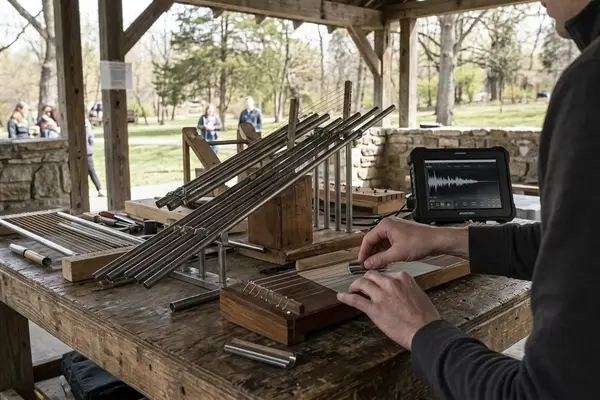
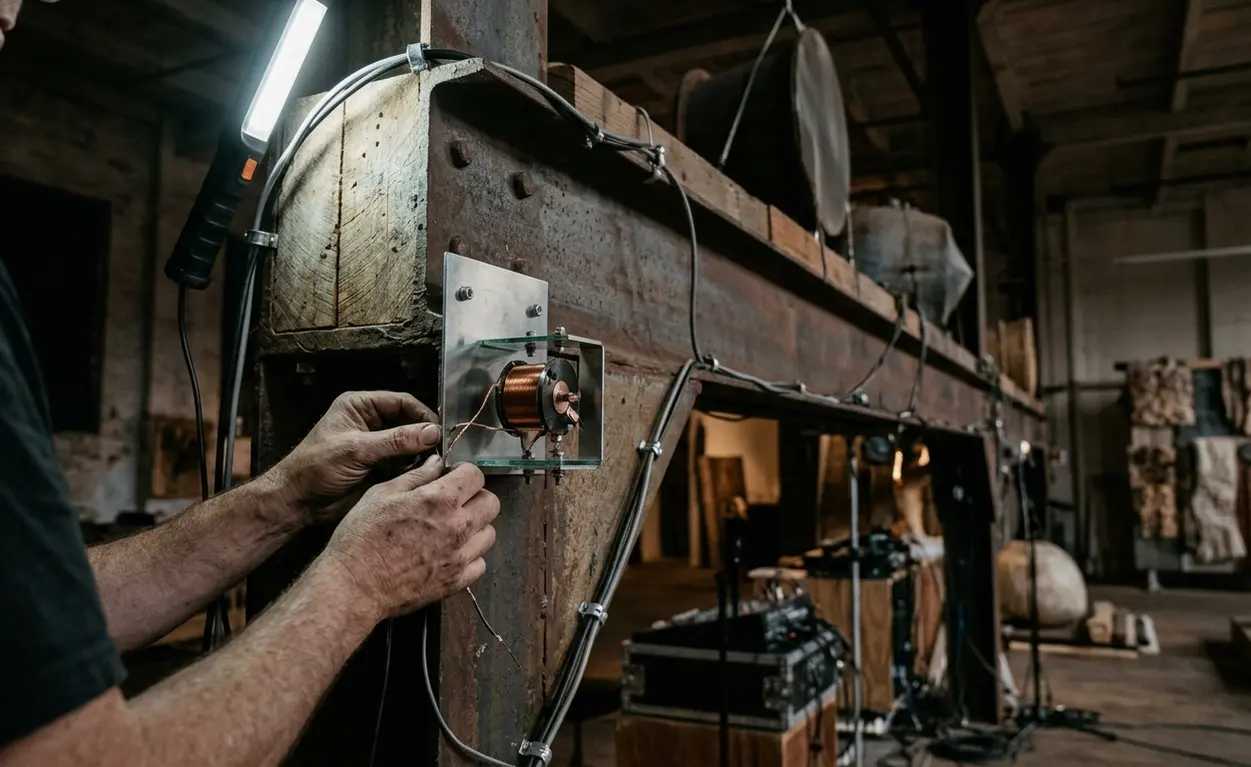
Hollow logs, culverts, abandoned metal sheets, fences, and stone chambers may already hold a voice. The artist’s job is to find the frequency that wakes it without damaging it, overwhelming it, or turning the site into a stunt.
Test local materials with low-gain sine sweeps from roughly 40 Hz to 4 kHz, stopping when the object rattles, buzzes, or produces an unstable mechanical response. Mark resonant blooms by ear and confirm them from several listener positions. A frequency that feels powerful beside a metal structure may vanish ten meters away.
Contact transducers can be effective, but they deserve caution. Start at very low amplitude before moving to open-air speakers. Found materials are not studio instruments. They may be brittle, inhabited, historically sensitive, or simply not yours to stress.
Psychoacoustic tuning works best when it leaves room for doubt. A listener may not know whether the fence is singing, the drone is bending, or their own ear is manufacturing a beating pattern in the dusk. That uncertainty is not a flaw. It is the place where site-specific sound stops illustrating the landscape and starts sharing agency with it.
Teardown is part of the composition. Make two passes: one for visible hardware such as speakers, batteries, sensors, and cables, and a second slow pass for tape, ties, flagging, cable scraps, and footprints around concealment points.
Leave no trace is not a decorative ethic here. It is the final technique. The work should exit without leaving plastics in the bracken, adhesive on stone, cable fragments in soil, or a disturbed habitat disguised as artistic intensity.
Bottom Line: The best site-specific installations disappear physically but linger acoustically.