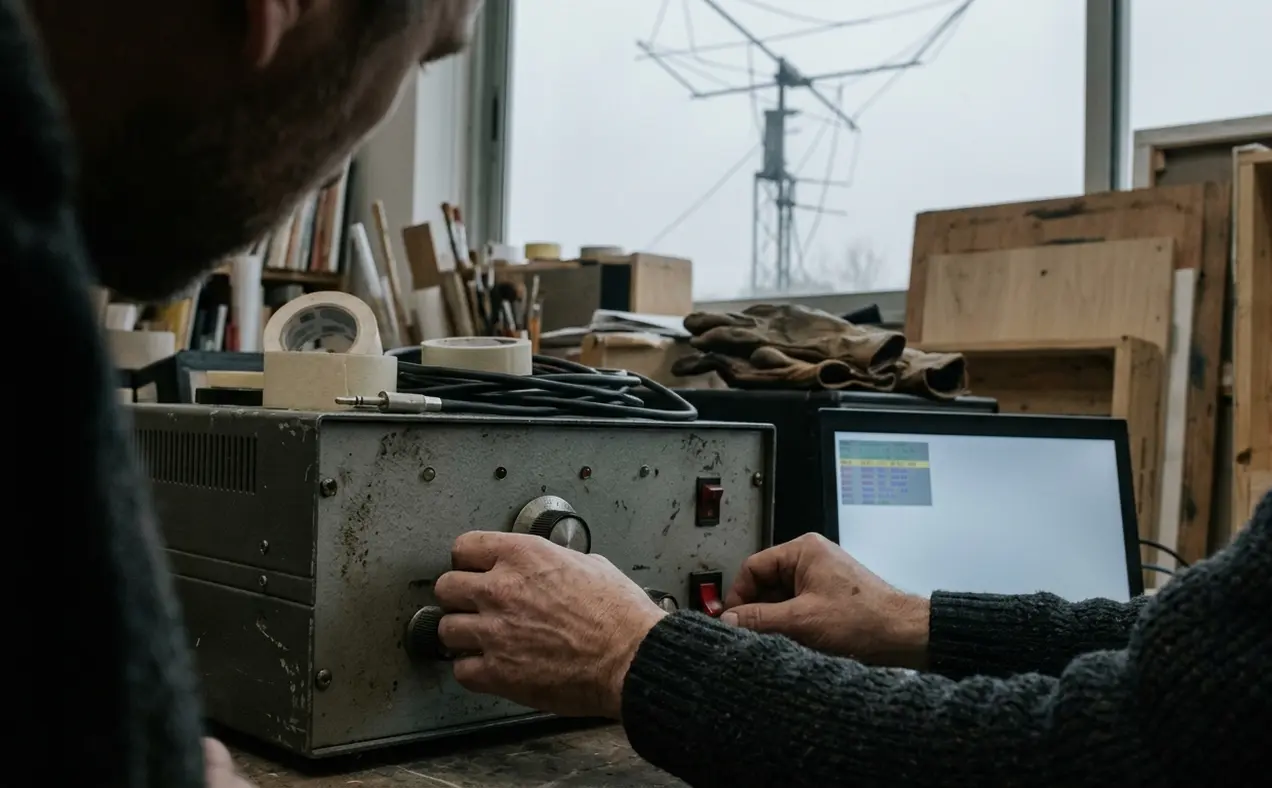
Broadcasting to the Void: The Allure of Remote Transmission
What happens when you broadcast avant-garde electronic music into a place where no one is listening?
The tension sits between the urge to send a signal and the constraints of off-grid sites. I treat the terrain itself as the first audience. Mastering Restricted-Service FM mechanics turns those isolated spots into temporary acoustic galleries.
Navigating the Scope and Limits of Restricted-Service Licenses
The licensing decision precedes any artistic plan. Site coordinates, dates, antenna height, output power and chosen frequency are fixed first because a remote transmission still crosses legal boundaries.
In the United Kingdom a short-term FM Restricted Service Licence is bounded by a temporary operating period, often up to about 28 consecutive days, with technical parameters set in the licence. In the United States unlicensed FM operation under Part 15 is governed by field strength: the limit is 250 microvolts per meter measured at 3 meters. A 1 W to 5 W transmitter normally requires authorisation or site-specific permission.
Frequency checks must cover occupied local channels, adjacent spacing and receiver monitoring near access roads or ranger stations. Restricted Service Licence (RSL) guidelines make clear that remote does not mean legally silent.
Powering the Signal: Off-Grid Energy Management
The power system is sized from the listening schedule backwards. Start with daily transmit hours, then add the transmitter’s DC draw, audio source and any processing.
A small 1 W FM transmitter may draw roughly 4–8 W DC; a 5 W unit may draw roughly 12–22 W DC before accounting for the player or mixer. For a 5 W RF setup drawing 18 W total for a 10-hour nightly transmission over 3 nights, plan for at least 540 Wh before reserve; with cold-weather margin and conversion losses, a 700–800 Wh battery budget is more realistic.
Deep-cycle SLA batteries are treated as roughly half their nameplate capacity for field planning, while 12.8 V LiFePO4 packs offer deeper usable capacity but may block charging below freezing. The basic chain runs solar panel to charge controller to battery to fused DC bus, with separate fused feeds to transmitter and audio source. An inline fuse sits within 15–20 cm of the positive battery terminal.
Topographical Challenges and Antenna Placement
The antenna decision follows a walk across the terrain. Mark the intended acoustic zone, note ridgelines and absorptive features, then select a pattern that matches the site.
For FM, wavelength ranges from about 3.43 m at 87.5 MHz to about 2.78 m at 108 MHz. A half-wave dipole’s total length is commonly estimated as 143 divided by frequency in MHz, then trimmed during tuning. At 100 MHz this starts near 1.43 m total, or about 0.715 m per side. A quarter-wave ground-plane at the same frequency begins with a vertical element near 0.715 m and radials of similar length.
Line-of-sight distance in kilometres can be roughly estimated as 3.57 times the sum of the square roots of antenna and receiver heights in metres. Wet conifer stands and valley walls reduce and scatter VHF reception; bare ridges and frost-hard ground may extend the signal unexpectedly.
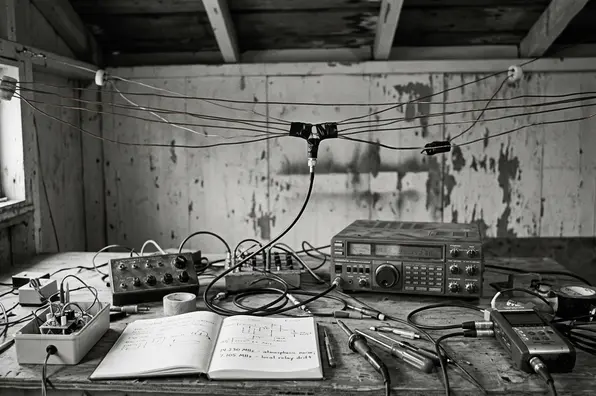
The Acoustic Ecology of the Broadcast
The composition is finished only after the first field monitor pass. Listen to the transmission at several distances and levels rather than mastering for clean studio playback.
In a late-autumn moor-edge test the antenna was placed just below a ridge crest so the signal remained strong on the track but broke into intermittent hiss in the peat hollows below. During a 3-hour evening window light rain and wet vegetation softened the outer zone; when the cloud lifted the same route produced sharper stereo-image collapse and clearer mono pickup at the fringe.
Test the piece in mono through a small battery receiver at the edge of intelligibility. Useful choices include slow attacks longer than receiver mute behaviour, midrange drones that tolerate hiss, sparse transients that let static become audible, and intentional silences of 20–40 seconds.