Galloway Forest Park is often described by what it withholds: streetlight, glare, the flat wash of towns on cloud. For site-specific sound, that absence is not empty. It is a working condition, as material as wet spruce bark or a receiver slipping from stereo into hiss.
The park asks for a different kind of broadcast: not a signal thrown across a market, but a narrow, temporary intervention placed where darkness, terrain, weather, and human expectation start to interfere with one another.
What's Inside
- Does Absolute Darkness Change How We Hear?
- The Acoustic Architecture of the Biosphere
- Topographical and Environmental Constraints on RF
- Deploying an Off-Grid Transmission Rig
- The Psychology of Unheard Music in the Wilderness
Does Absolute Darkness Change How We Hear?
Darkness changes the contract between body and place.
Once visual detail drops away, listening stops being decorative. The ear begins to take measurements: distance, surface, movement, threat, shelter. A twig snap behind the shoulder carries more information than a view ever did. The same small sound that would vanish beside a car park becomes architectural when the path, the tree line, and the horizon have disappeared.
Dark-sky status as a curatorial trigger
Galloway Forest Park received International Dark-Sky Association recognition in 2009. That date matters because the designation has had time to shape visitor behaviour, ranger practice, and public expectations around darkness. People now arrive prepared to experience the park after light has gone, not merely to pass through it on the way back from somewhere else.
For sound curation, the designation offers more than a scenic label. It gives permission to treat darkness as a medium. The listening premise begins when the park is understood not as a visual void, but as a specific dark sound environment: damp air, unlit forestry track, cold receiver casing, low cloud holding the night close to the ground.
Bottom Line: A sound work in Galloway Forest Park should not simply accompany darkness. It should use darkness as one of its instruments.
When the session should actually begin
A field session should normally begin after civil twilight has fully passed, not at sunset. Sunset still gives the listener enough visual structure to soften the perceptual shift: silhouettes, path edges, the last readable depth in the sky. The intended threshold arrives later, when the eye can no longer tidy the landscape into reliable forms.
The strongest seasonal window runs from late autumn through early spring. Darkness arrives before typical evening travel ends, and the weather becomes part of the system. Leaf moisture, low cloud, and cold air alter both acoustic behaviour and radio behaviour, so the park does not simply get darker; it gets technically stranger.
The Acoustic Architecture of the Biosphere
The site is selected by ear before it is selected by map. A forestry compartment, an open moor edge, and a loch shore may sit close together on paper, but acoustically they are different rooms.
Spruce as absorption, moor as exposure, loch as reflector
Dense Sitka spruce plantations create a soft, close field. Needle litter, trunks, and low branches break up short, high-frequency sounds: footfall crackle, clothing movement, the small scrape of a case latch, the brittle noise of handling equipment with cold fingers. Inside these blocks, sound feels near to the body. It does not travel cleanly; it is caught, folded, dulled.
Open heather moorland behaves differently. Wind is less filtered there. Gusts arrive as moving pressure, not just as hiss in a canopy. The listener hears the weather crossing space.
Loch edges provide the hard horizontal surface the forest withholds. Low-frequency content can carry across water for noticeably longer distances than the same material played into dense trees. Bass pulses and sub-bass drones begin to feel spatial rather than merely loud, as if the loch has been added to the signal path.
The baseline is not silence
Treating the park as an empty wilderness is the first curatorial error. The work depends on the existing soundscape: wind shear through conifer crowns, water movement at the shore, owl calls, deer movement, and the intermittent clicks and snaps of wet vegetation cooling after dusk.
That baseline is not background in the passive sense. It is the bed the transmission must either disturb, braid into, or deliberately leave exposed. A continuous electronic drone may flatten it. A sparse pulse may reveal it. Short gaps can be more useful than spectacle because they let the site re-enter the ear.
Field Note: At a loch edge after rain, low tones may travel beautifully over water while reception becomes unstable inside nearby spruce. A dry moorland setup may give cleaner radio pickup but less enclosing darkness.
Topographical and Environmental Constraints on RF
The park constrains the technical plan before the artwork gets to make its demands.
VHF/FM propagation is fragile where wet foliage sits between transmitter and receiver. Soaked spruce branches and dense biomass absorb and scatter the signal enough that a clean test in dry air can become patchy after rain. This is not a minor inconvenience; it changes the shape of the piece. The listener may walk a short stretch and move from stable stereo to hiss, mono collapse, or complete dropout.
Folded terrain and reception shadows
Steep-sided forest roads and glens create abrupt reception shadows. A transmitter that appears sensibly placed on a map may behave poorly once the receiver drops below surrounding ground or turns into a plantation corridor. In Galloway, line-of-sight is not an abstract engineering preference. It is the difference between a faint ritual and an inaudible one.
The temptation is to answer these limits with power. That is usually the wrong artistic move. A technically stronger transmitter placed near a generator, vehicle access point, or busy trail could produce a clearer signal, but it would make a poorer artwork because the acoustic baseline would be contaminated by human infrastructure.
Temporary means temporary
Environmental regulation is not an obstacle to the work; it is one of the shaping forces. Installations need to be temporary: no ground cutting, no permanent cabling, no loud power source, and no hardware left after the listening window closes. Forestry roads, visitor routes, habitats, and working land use all matter.
Visitors planning access should check current site information through Forestry and Land Scotland, especially where weather, forestry operations, or seasonal conditions may affect routes.
Important: This model suits tightly localized, permissioned sound-art transmission; it is not a template for public broadcasting across the whole park.
Deploying an Off-Grid Transmission Rig
Deployment starts with listening, then scanning, then transmission. The order matters. A crew that arrives only to set up gear has already missed the main instrument.
A practical low-wattage rig
The working rig is modest: a low-wattage FM transmitter, a compact audio player or sampler, a charge controller if solar is used, sealed battery storage, weatherproof cabling, and an antenna that can be removed without trace. Nothing should look permanent. Nothing should need to be explained away in daylight.
Power should come from silent battery packs or a solar-assisted battery system. Even distant engine hum can mask the high-frequency details of wind, needles, and small animal movement. A small generator would be acoustically larger than the artwork, which is why it fails the site even if it solves the electricity problem.
Sequence for a single evening or overnight session
- Arrive in daylight and walk the intended listener route without transmitting.
- Identify a dry equipment position away from main visitor paths and obvious ridgeline silhouettes.
- Listen for the baseline: wind direction, water movement, animal activity, road bleed, forestry noise.
- Scan the local FM band on site before selecting any working frequency.
- Check adjacent services and avoid any conflict with emergency, forestry, or wildlife telemetry use where applicable.
- Place the antenna low and temporarily, favouring line-of-sight over a loch or open moor edge where the composition needs reach.
- Install before dusk, operate through the agreed window, and remove the equipment before morning visitor traffic increases.
Frequency selection is not a decorative admin task. It is part of the ethics of the piece. The artwork has no right to interfere with emergency services, forestry operations, or tracking systems that may be doing quiet work elsewhere in the landscape.
Bottom Line: The best rig is not the most powerful one. It is the quietest complete system that can hold a local signal without leaving a trace.
The Psychology of Unheard Music in the Wilderness
The listener travels to coordinates, loses visual certainty, tunes through static, and finds a signal that is not available elsewhere. That sequence is not logistics. It is the score.
Unfamiliar sound behaves differently in darkness
Unheard electronic material suits this setting because there is no prior memory of the track to stabilize the experience. The listener cannot say, with comfort, where the sound belongs. A thin tone may be part of the transmission, a wet branch shifting, receiver noise, or the body’s own nervous editing of the dark.
The strongest psychological effect occurs when the source cannot be seen. Once the speaker, transmitter, or performer is visible, the mind files the event under ordinary categories. In darkness, with a small radio in hand, the sound remains unclaimed for longer. Synthetic tones become entangled with wind, animal sound, mud underfoot, and the cold pressure of being away from infrastructure.
Why short broadcasts can cut deeper
Continuous playback can make the wilderness feel like a venue. Short-form broadcasts do something sharper. Gaps, fades, and carrier noise remind the listener that the work may disappear at any moment.
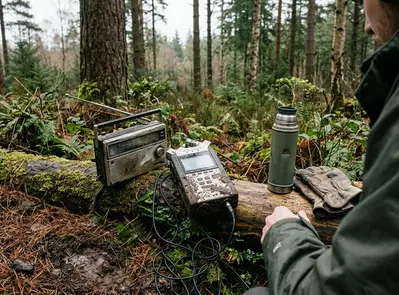
That fragility is the point. The piece is completed only by travel, tuning, and bodily exposure: cold hands, uncertain footing, distance from signal certainty, the private embarrassment of standing still in a forest to hear something no one else may hear. Community feedback confirms what many site-responsive practitioners already suspect: the memory often attaches less to the track itself than to the act of finding it.
The broadcast does not need to conquer Galloway Forest Park. It needs to appear briefly inside its darkness, accept the argument of terrain and weather, and vanish before the site has been made to serve it too neatly.