Broadcasting to the Trees
The equipment case hits the wet ground first. Before any power flows, the antenna line must be pulled up into the canopy. A simple FM dipole cut for the middle of the band requires two wire legs, roughly three-quarters of a meter each, before trimming for the chosen frequency. Only after the antenna is secured and connected to the load should the deep-cycle battery meet the terminals. Powering a 1-watt FM exciter into empty air will quickly stress the output stage.
This dusk setup window usually lasts something like 35 to 55 minutes. It provides just enough time to raise the antenna, verify the carrier presence on a portable receiver, and seal the equipment case before full dark sets in. The physical sensation of connecting the battery and watching the antenna catch the wind grounds the entire project in the immediate environment.
Why go through this effort for a broadcast that will never be recorded, archived, or streamed?
The Heavy Burden of Infinite Permanence
The modern streaming ecosystem demands endless availability. This architecture strips experimental sound of its physical context and mystery. The argument for ephemeral radio turns on a choice made before composition even begins: whether the work is meant to survive as a file or to disappear as an encounter. Once the archive is removed, the composer stops optimizing for playlists.
Where digital distribution models dictate listener habits, the finding follows that endless availability flattens attention. For an ephemeral work, a single continuous transmission block of two to six hours creates a radically different listening contract than a looping file available indefinitely.
Announce only the frequency, the access instructions, and the listening window. Do not publish a track list, a download link, or later documentation. The absence of a record button must be made explicit at the site. There is no capture rig, no stream encoder, no post-broadcast upload, and no hidden archival feed. True avant-garde electronic music thrives on this temporal fragility.
The Mechanics of Restricted-Service FM
Hardware choices should follow the terrain rather than the catalog. In a flat clearing, a low dipole may be enough to saturate the immediate area. In a folded valley, that same transmitter becomes a lantern pointed into a wall.
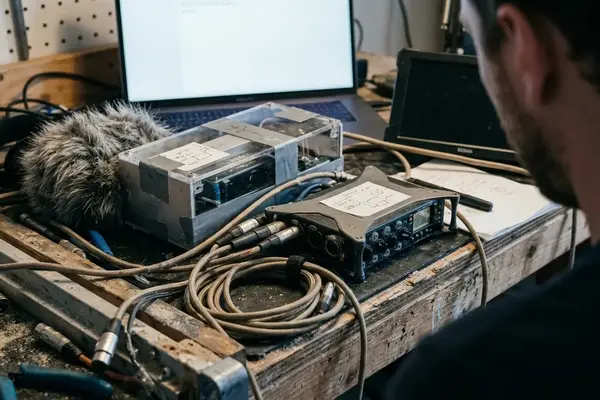
A remote kit can be reduced to a few essential components. You need a low-wattage FM transmitter, a wire dipole, a short coax run, an inline fuse, a weather-resistant box, a 12V battery, and a small receiver for verification. A 12V sealed lead-acid battery in the 18 to 35Ah range serves as a common practical size for overnight or day-long low-power transmission tests, depending on transmitter draw and temperature.
Sustained field deployments across varied topographies over consecutive seasons reveal how dense leaf cover, wet bark, ravines, and metal roofing change the usable listening area more dramatically than a small increase in transmitter output. One thing to watch: low-power FM remains a line-of-sight, weather-sensitive medium. Legal operation depends on local spectrum rules, occupied channels, antenna configuration, and measured emissions rather than artistic intent. Reviewing the guidelines for low-power, restricted-service broadcasting ensures compliance before powering the exciter.
Tuning the Signal to the Terrain
The composition process begins with a listening visit, not a synthesizer preset. Record no master document. Instead, make notes on what the place already produces: insect bands, leaf hiss, or moving water. The environment acts as a co-producer of the broadcast.
A transmitter that sounds clean on a test bench can fail artistically in a wet valley because the strongest audible feature becomes multipath flutter rather than the composed signal. Atmospheric conditions interact heavily with analog radio frequencies. Humidity and evening temperature drops make outdoor receivers feel less stable because connectors, battery performance, and improvised antenna positions all change as the site cools.
Wind creates audible variation without touching the audio file. A moving wire antenna, shifting listener orientation, and foliage motion alter reception at the edge of range.
Field Note: A useful site sketch marks three zones: the clear-carrier center, the broken-stereo or noisy middle ring, and the outer fringe where static becomes part of the composition.
Executing Your First 24-Hour Unrecorded Transmission
For a first 24-hour unrecorded transmission, choose one contained terrain feature. An abandoned concrete structure, a bowl-shaped valley, or a stand of trees with a natural gathering point works best. The same 0.5-watt setup may feel intimate in dense trees, disappear behind a granite shoulder, or travel unexpectedly across open water. The landscape is not scenery—it is part of the transmission chain.
Assemble a 0.5-watt FM transmitter, a 12V sealed lead-acid battery, a portable media player running one generative audio patch, a wire dipole antenna, short coax, an inline fuse, a weatherproof enclosure, and a handheld receiver. For a 24-hour run, pair the transmitter and media player with a 35Ah sealed lead-acid unit to provide practical margin and cold-weather headroom.
Elevate the dipole two to four meters using a beam, window opening, tree limb, or cord thrown over existing structure. Keep the coax strain-relieved so wind does not pull directly on the transmitter. Ground or bond metal enclosures where appropriate with a temporary stake or clamp, and protect connections from condensation.
Tune by scanning the local FM band in channel steps appropriate to the region. Confirm the candidate frequency is quiet at the site and at the nearest public access point before transmitting. A dead frequency at noon may be unusable after dark if distant stations begin to appear on portable receivers, so the final dial check belongs immediately before the broadcast. When the 24 hours conclude, remove every tie, cord, battery, stake, and wire.