What's Inside
- High-mid detail and held silence at the listening post
- Capsule pressure set apart from canopy rustle
- Bands left open for water, branches, and wind
- A high-pass slope judged on the small driver
- Horns, pre-emphasis, and the pocket receiver
High-Mids and the Silence a Valley Can Hold
Monumental outdoor sound art stands on high-mid detail and on silence placed on purpose. The judgement is what remains legible at the listening positions. A thrill beside the source is a private event. Restricted-service FM into a remote valley is a short transmission: listeners walk in, the frequency is present, then the dark outside takes it back. The mix has to survive that walk.
Club systems teach a confidence the valley will not honour. Four walls, a floor, and a ceiling support room modes and boundary gain. Low frequencies stack against those surfaces until the chest reports power the open air will not confirm. An open site offers fewer reinforcing boundaries. The same sub-bass programme leaves the stack and meets ground, canopy, and sky. The tactile illusion stays in the room you mixed in.
An ideal point source in a free field loses approximately 6 dB of sound-pressure level with each doubling of distance. Geometric spreading belongs to the field, shared across the spectrum. Distance taxes a 3 kHz partial on that same slope, give or take. Bass arrives at the post already stripped of the modal boost the club had been donating. Published outdoor sound propagation and atmospheric absorption standards belong in the same notebook as the walk-away log: path, air, and ground are mix parameters.
Heavy low-frequency content consumes amplifier headroom and driver excursion. The portable pack drops. The cone travels. The chest-thump associated with a powerful enclosed system stays behind. Wattage spent on that missing sensation is wattage the high-mids never receive.
Posts Before Patches
Lock spectral balance only after standing at the intended audience positions. A balance struck against the stack has not yet heard the site.
Held silence does structural work once the walls are gone. A single brittle attack, with air around it, reads as an event against wind and distance. Continuous sub-energy, with nowhere to reflect, becomes a drain on the pack and a blur at the post.
Legibility at the Tree Line
A pocket radio at the tree line reports a different balance than a nearfield monitor at the desk. The nearfield still has the desk, a wall, and a body as boundaries. The pocket radio has a coat, a gust, and open ground. Walk the doublings of distance and note whether the gesture is still nameable. If recognition depends on standing next to the driver, the gesture is studio furniture. High-mid texture with space around it is the material that still carries form after boundary gain drops out.
Write the log in plain terms: entrance heard, entrance lost, battery sag, cone complaint. That page is the score for the next pass.
Capsule Pressure Set Against Canopy Rustle
Wind and foliage occupy different jobs in the same hour. Choose the EQ curve only after those jobs are separated. Wind striking a microphone capsule produces local pressure fluctuations that can overload a recording even when the surrounding acoustic sound is much quieter. An overloaded file will beg for a low cut that the ear, standing in the same gust, never asked for.
Two Listens for One Gust
Make a wind-protected recording, then listen directly at ear height with the recorder out of the decision. Compare them before a single filter moves. The protected take shows the site. The bare capsule shows the diaphragm arguing with moving air. If the two disagree in the bottom octave, the disagreement is local pressure, and it should not write the mix.
Then name the dominant mask at the post itself. Gust rumble, leaf noise, and terrain-related cancellation rarely share a remedy.
- Gust rumble sits low and steady. Added sub-bass merges with it. Contrast collapses, and the ear tires on a sustained level with no edge to lock onto.
- Leaf noise lives higher. Pine needles and moving branches compete directly with the high-mid textures a field piece is likely to trust.
- Terrain cancellation moves when you move. Trunks, ground impedance, source height, and the slope underfoot all change the received sound. A null at one stump can be a clear entrance something like ten paces on.
Foliage generally scatters and attenuates shorter wavelengths more effectively than long bass wavelengths. Dense canopy and needle clusters take a brighter partial harder than they take a slow fundamental. Long bass wavelengths pass that scatter and then meet the wind mask anyway. The terrain is therefore two competitors, not one rumble assigned to every band.
Diaphragm Before EQ
If the capsule clips in a gust while speech beside the stand remains ordinary, fix the wind protection before you touch the low shelf. Chasing that overload with mix EQ carves a hole the listeners never heard.
Fatigue From a Level With No Edge
Fighting ambient low-end rumble with amplified sub-bass produces an indistinct wash. The wash is a contrast failure. Sustained level, with the artistic gesture buried inside the same band as the gust, wears the attention out of a pilgrimage listen. Listeners who walked in for a day-long transmission deserve an entrance they can separate from weather. Give them that edge in a band the gust is not already filling, and keep the sub from spending the amplifier on a mask it cannot beat.
A useful field note is short. "Gust owns below the voice. Needles own the bright rustle. Null behind the third trunk." That sentence chooses the curve. A spectrum plot of a wind-struck capsule, taken alone, will choose a worse one.
Bands Left Open for Water and Branches
A spectral gap is a region left comparatively unoccupied so the acoustic ecology can enter as an active voice. Nearby water, moving branches, and canopy noise already hold pitches and rhythms. The electronic material either shares those regions and disappears, or it steps aside and lets the site finish the phrase.
A Survey Before Any Resonant Attack
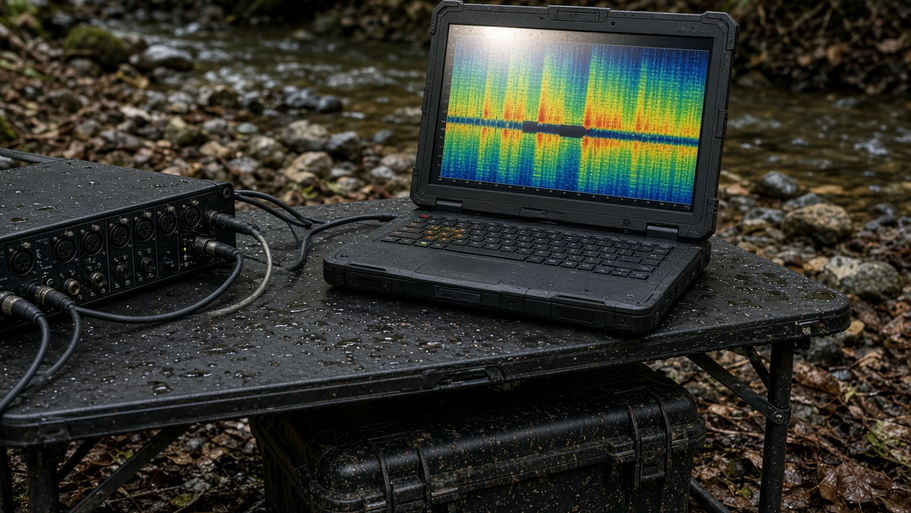
Walk the transmission zone and mark what already speaks. A stream two bends away may own a narrow mid band that a soft oscillator would only smear. Branch knock may own the transient slot you planned for a click. Canopy hiss may sit exactly where a bright granular cloud wants to live. Leave those regions thinner in the patch. The gap is composed, the way a rest is composed.
Then audition brief resonant attacks from several positions among the trees. Keep the sounds whose entrances remain identifiable. Discard the ones that only announce themselves beside the loudspeaker. This is a repeatable field method: survey, thin the occupied bands, walk the attacks, retain what still has a name at the posts.
The canopy already has a part. Writing a second part in the same register turns both into weather.
Use 1.5–5 kHz as an audition range for resonant textures. That span holds perceptually prominent detail. It can also turn piercing, and it can compete with foliage noise. The canopy-gap breakdown is specific: a supposedly hardy texture in that span vanishes into leaf rustle when the composition occupies the very band assigned to the surrounding woods. If the survey already gave the needles 2–4 kHz, a resonant cloud parked there is a duplicate, and the duplicate loses.
Rustle Keeps Its Band
When leaf noise and the patch share 1.5–5 kHz, move the electronic weight to a neighbouring region the survey left quieter. The rustle stays the voice. The patch becomes the interruption.
Entrances the Two Ears Can Place
Transient onsets and interaural level differences support localization. A listener can point at a sharp attack among trunks when the two ears receive different levels and a clear start. Apparent movement asks for changing spatial cues, such as alternating physical sources around the clearing. High-mid content, played from one fixed horn, stays a fixed object with a bright timbre. The haunting sense of something passing between trees comes from those changing cues, timed against the gaps you left for wind.
Wind shear is a change in wind velocity with height, and it refracts sound along the path. Audition upwind and downwind after that refraction has done its work. Retain the attacks that still announce themselves at both posts. A favoured kilohertz band is an audition window, a place to listen harder, and the walk decides what survives the bend in the path.
Wattage follows from that decision. An attack that remains identifiable at several tree positions has already proved it can travel on the amplifier you brought. A sub that only feels large at the cone has proved the opposite, at a higher excursion cost.
A Slope Judged on the Receiving Cone
The patch has to pass a loudspeaker that fits in a pack, or a pocket radio a listener carries up the track. Studio weight below the desk is a different instrument. Route the material through the intended receiver and the intended loudspeaker before the cutoff is chosen.
Cutoff Heard Where the Cone Travels
Audition a high-pass between 120 and 180 Hz on that receiving loudspeaker. A 24 dB-per-octave slope is a concrete starting setting, more or less. It attenuates frequencies below the cutoff progressively. Energy remains under the knee, quieter with each octave, available for a check against musical weight.
Choose the cutoff by comparing three things at a matched listening level: driver excursion, audible distortion, and loss of musical weight. At a given acoustic output, reproducing lower frequencies generally demands greater driver displacement. Reducing that demand reduces excursion-related distortion. The cone complains because it is travelling, and the travel is what the filter is there to bargain with.
The 120–180 Hz window is a small-driver, portable-power strategy. Installations with purpose-built subwoofers, and works whose essential material is physical low-frequency pressure, sit outside that choice.
I set the final number at the receiving loudspeaker, where excursion relief and the survival of an implied fundamental can be heard together. A cutoff that frees the cone and kills the pitch is the wrong cutoff. A cutoff that keeps the pitch and still lets the cone flap on gust peaks is equally wrong. The pocket-receiver boundary is that paired listen.
high-pass slope: 24 dB/octave
cutoff audition: 120 Hz to 180 Hz
comparison: alternate 20-second excerpts, filtered and unfiltered
level match: midrange, same receiver position
keep: excursion eased, implied fundamental still readable
Partials That Can Carry a Missing Fundamental
Once the slope is in play, move weight into an ordered harmonic series. FM synthesis, ring modulation, and granular pitch-shifting are the practical tools. Missing-fundamental pitch depends on the relationship between audible partials. An ordered series can suggest a low note the small driver is no longer asked to produce. Metallic sidebands from ring modulation, and inharmonic FM, need a separate check before they are trusted to suggest any particular bass note. If the partials do not line up, the ear hears metal, and the fundamental you hoped to imply never forms.
Run the comparison as a fixed protocol. Alternate 20-second excerpts of filtered and unfiltered material at a matched midrange level, using the same receiver position. Matched midrange stops the louder take from winning by sheer level. The same position stops a terrain null from masquerading as a filter victory.
Field-transmission soundcheck
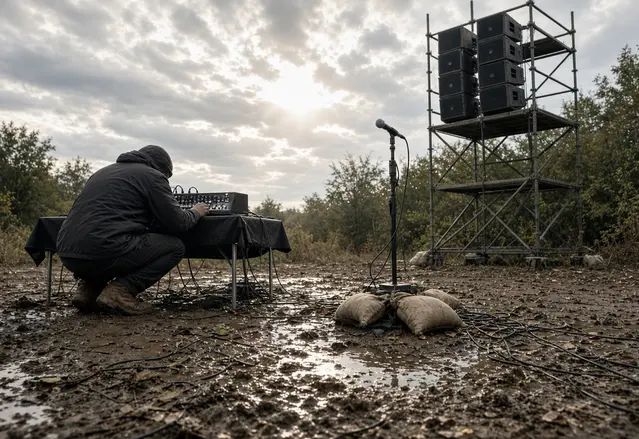
- Listen at the intended audience positions before setting the spectral balance.
- Distinguish microphone wind rumble from the sound heard directly at the site.
- Compare high-pass settings through the actual receiver and loudspeaker.
- Confirm the implied fundamental still reads after the slope, on that same loudspeaker.
- Confirm the principal gestures still read after the receiver is summed to mono.
The unfiltered excerpt will often feel larger in the studio. The filtered excerpt is the one that still has a shape once the cone stops wasting throw on air the site will not hold. Keep the take the post can name.
Horns, Pre-Emphasis, and the Hiker's Radio
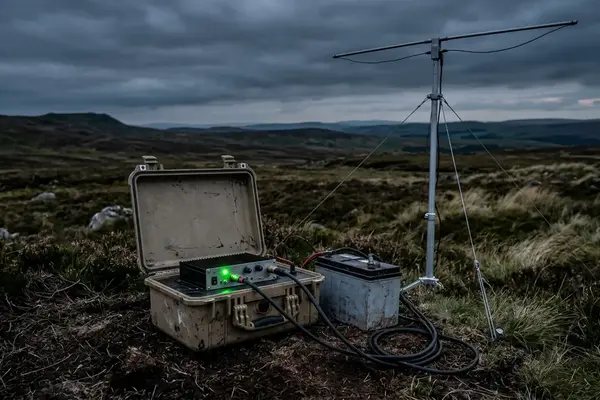
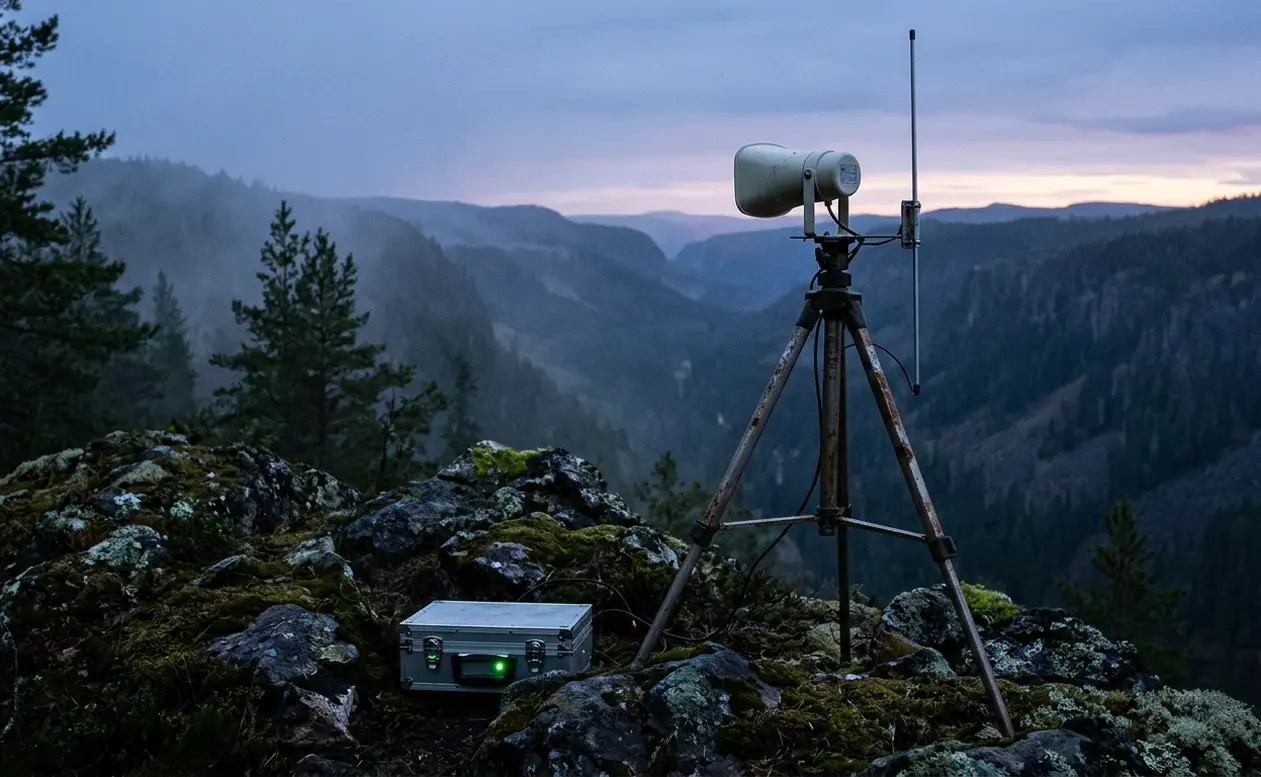
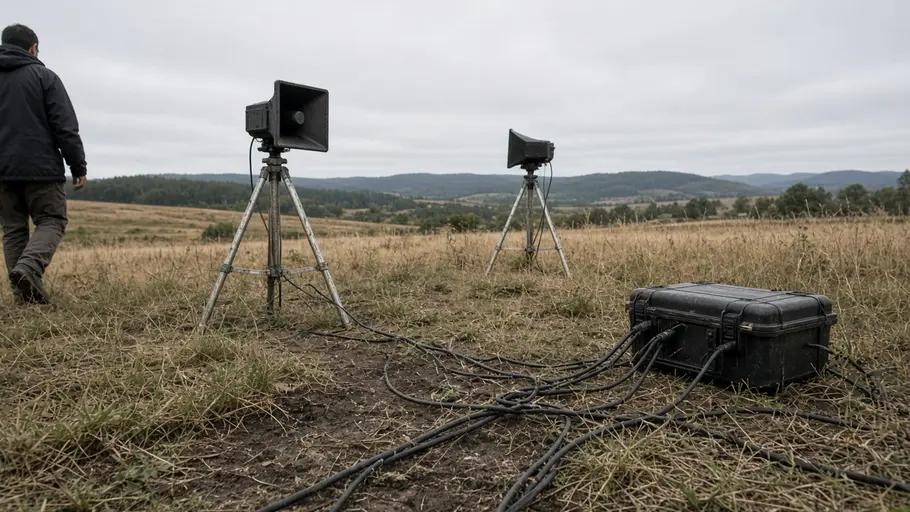
Field hardware ends the argument the studio monitors started. Battery-powered PA, weatherproof horns, and the small radios people carry into a transmission zone are the real playback system. Make the smallest intended receiver part of the monitoring chain, beside the installation loudspeaker. A piece that only exists on the array, and falls apart in a pocket radio, fails the listeners who made the walk.
What the Full Path Must Still Pass
Check four things through the complete transmission path. Mono intelligibility. Amplifier limiting. Enclosure rattles. The audibility of quiet entrances. A soft attack that the studio treated as spatial detail can vanish once a limiter has been working and a plastic case is buzzing in a coat pocket. Quiet entrances are the spectral silence from the first decision, arriving as sound. If the path eats them, the gaps you carved never reach the trees.
A high-frequency horn driver must be protected by its specified crossover or high-pass filter. An artistic bass cut on the master bus leaves that protection untouched. The musical slope between 120 and 180 Hz is a mix decision. The horn's own filter is a survival condition for the driver. Both stay in the chain.
Damp, cold air changes how long a battery pack holds voltage and how steadily a listener can hold a small radio to an ear. Cone distortion still tracks displacement. Weather belongs in the power and handling log. Excursion belongs in the filter log. Mixing those two notes produces the wrong repair.
Pre-Emphasis Beside the Limiter
Conventional FM broadcast chains commonly use 50 or 75 microseconds of pre-emphasis, depending on the regional system. Receiver de-emphasis complements that curve. Heavy bass can drive a broadband compressor or limiter when that processor sits in the chain. Limiter pumping then depends on processor placement, detector behaviour, and time constants. Read the pump from those settings. Read pre-emphasis as the regional high-frequency curve the receiver will undo. A sub-heavy master that keeps hitting a broadband limiter will crush the delicate spatial detail of an experimental piece, and the crush will show up as flattened entrances on the hiker's radio, with the de-emphasis curve still doing only its own job.
Receiver mono playback can erase or alter material built from out-of-phase stereo components. Many pocket radios, and many restricted-service listening situations, sum the signal. Verify that the piece's principal gestures survive that sum. A width trick that collapses into a hole at the post was never a gesture. It was a studio phantom.
The transmission is ephemeral by design, a day of unheard electronic music offered to whoever reaches the zone. The archive of that day is the log: positions, cutoff, which partials still implied a low note, which attacks the needles swallowed, which quiet entrance the limiter ate. The next patch is already waiting on the same physics.