Why Broadcast a Story to an Audience of Zero?
Standard VHF FM radio waves travel through air at approximately 300,000 kilometres per second. A granite ridge can obstruct, absorb, diffract or reflect their energy. Send a story into an empty basin and its route immediately becomes physical: over a shoulder of rock, into a screened hollow, back from an exposed face.
The proposed Lost Cosmonaut intervention gives that journey a narrative. A fictional orbital capsule deteriorates through a continuous electronic score, broadcast into remote landscapes without permanent human inhabitants. Months of sequencing might reach someone for a passing moment. The launch might have finished before a receiver leaves its rucksack.
That possibility gives the commission its pressure.
Earlier ambient transmissions provide the conceptual starting point: extended textures, loose entrances, listening without a prescribed beginning. A sequential score changes the terms. A listener arriving during the capsule’s final descent cannot recover the launch simply by remaining tuned in. The programme has moved on.
This account treats the supplied intervention as a design scenario. Its cold-weather faults and granite-shadow reception patterns are conditions to rehearse and investigate, rather than documented results from a completed broadcast. Keeping that distinction clear makes the field method useful: every claimed transformation needs a listening record.
Give the Passing Listener a Foothold
The narrative needs enough local detail to survive partial reception. A recurring pulse, a restricted spoken vocabulary and recognisable changes in machinery can suggest an inhabited capsule even when the listener misses its departure. Those details carry identity across discontinuous encounters.

At approximately 100 MHz, the wavelength is roughly three metres. The apparently immaterial transmission has dimensions close to the equipment carried uphill. Antenna geometry, rock faces and the listener’s position all belong to the work’s material conditions. Audience size answers a different question: how many people happened to enter that arrangement while it remained active?
Structuring the ‘Lost Cosmonaut’ Audio Arc for Unforgiving Terrain
Build the cue sheet before collecting finished tracks. Establish the capsule, introduce failing communications, then destabilise its apparent orbit. Assign each producer a dramatic function. Sorting contributions by tempo or genre would leave the central problem unresolved: what changes aboard this vessel, and how does the listener hear it?
The commissioning brief should define shared elements while leaving room for individual approaches. One contribution might carry the pulse under a densely compressed interior drone. Another might leave it exposed beside a clipped voice. Continuity comes from the listener recognising an element as its surroundings deteriorate.
Make Silence Carry the Fault
Heavy low-mid material can suggest a sealed, vibrating interior. Abrupt rhythmic absences can interrupt that enclosure like missing telemetry. Silence needs placement: a break after a recognisable exchange carries different information from an empty interval between unrelated tracks.
Audition ten-minute passages that cross contribution boundaries. Beginning every review at the start of a track gives the score an advantage that passing listeners will never receive. The useful questions are immediate: can the capsule still be identified, does something change, and does the transition preserve a reason to keep listening?
Then take the score out of stereo.
The capsule can disappear at the mono sum. An out-of-phase distress voice may cancel before any signal reaches the granite, creating an accidental narrative loss inside the playback chain. Check the summed programme through an ordinary portable receiver and compare it with the source. Keep intentional disappearances on the cue sheet.
Preserve Contrast Within the Modulation Limit
Studio monitors can make a large crest factor feel thrilling. The transmission chain still needs measured peaks and controlled peak-to-average behaviour. Excessive deviation or an overloaded input causes the relevant distortion; a transmitter’s low output power does not inherently make it clip.
Check the actual exciter after preparing the programme. Low-mid weight should leave room for the voice, while short silences should remain perceptible after dynamics processing. Within sound art & experimental commissioning, this becomes a compositional constraint: intensity must survive a narrower delivery path without every passage settling at the same apparent pressure.
Powering and Weatherproofing the Field Broadcast Rig
A combustion generator introduces another performance into the site: an engine running beside a work concerned with listening. Deep-cycle marine batteries preserve the acoustic quiet around the transmitter. Their weight, usable capacity and behaviour in the expected cold then become part of the installation plan.
Assemble the entire rig before packing it. The signal chain runs from lossless playback through mono summing and dynamics processing, into the FM exciter or transmitter, then through coaxial cable to the mast-mounted dipole. An audio compressor cannot drive the antenna directly.
- Fuse the battery connection and protect exposed terminals.
- Provide strain relief where cables enter the enclosure.
- Keep a shutdown point accessible without dismantling the installation.
- Secure the telescopic mast and route its feed cable clear of walking paths.
Find the Voltage Loss Under Load
The scenario’s evening temperature drop calls for a diagnostic rehearsal. Log voltage at the transmitter input while the complete programme runs. An idle reading at the battery terminals can conceal losses along cables and connectors. Record the operating state alongside the reading so a playback interruption can be distinguished from a transmitter supply problem.
If voltage sags, stop and identify the cause before altering the rig. A poor connection, an unsuitable cable run and a cold-affected battery call for different responses. Insulating a battery enclosure may reduce exposure, but it does not replace an adequate energy budget.
Keep Water Away From the Remedy
A protective hard case, including a Pelican-style enclosure, still needs a moisture plan. Condensation forms when a surface falls below the local dew point. Warm electronics alone do not establish when or where that will happen.
Pack dry equipment, inspect seals and use desiccant with known remaining capacity. Opening the case to release moisture may admit humid air or precipitation. A baffled ventilation change needs splash protection, drainage and testing before deployment.
Dry Case Discipline
Evening rain stays on the closed enclosure beside the energised rig, the shutdown within reach, the seals dry under inspection, the connections checked before any open lid has to be balanced in the weather.
What Changed When the Signal Hit the Granite Ridges
The terrain’s contribution becomes legible through comparison. Play the same reference passage while walking a repeatable receiver route: an exposed ridge, a screened valley position, then a location beside a substantial rock face. Keep the receiver, antenna extension and listening procedure consistent.
A valley-floor dead zone is a plausible outcome, not an observation that can be claimed in advance. Terrain screening may leave weak-signal hiss or no usable reception. Reflected paths may introduce flutter and distortion. The route tests those possibilities against particular positions.
Write Down the Receiver’s Behaviour
A useful field record stays close to what the instrument and listener can establish. At each waypoint, record:
- The location, time and passage playing.
- Receiver orientation and antenna extension.
- Whether the voice and recurring pulse remain intelligible.
- Whether the receiver hisses, distorts, flutters or mutes.
- Signal strength only when the receiver actually supplies a reading.
Move the handheld receiver a short distance and repeat the check. At broadcast-FM wavelengths, that movement can change the mixture of direct and reflected signals. A sudden improvement does not establish that the listener has crossed a simple distance boundary. Position and orientation belong in the record.
Separate Composed Damage From Received Damage
Compare the location recording with the source master and cue sheet. A broken telemetry phrase already present in the score is composed material. Flutter appearing only at a rock-face waypoint is a reception artifact worth investigating. Listening alone may leave the mechanism uncertain; the comparison at least establishes where the change entered.
This is where the work can become especially strange. Receiver hiss may occupy a silence prepared by a producer. A reflected signal may roughen a pulse intended to sound mechanically stable. The place can extend the fiction through real degradation, provided the account preserves the difference between artistic interpretation and measured reception.
Broadcast archives should retain those distinctions: source master, processed transmission version, cue sheet and location recordings. A seamless composite would erase the evidence of how the place intervened.
Actionable Blueprint for Your Own Site-Specific Sonic Intervention
Prepare in dependency order. Permission affects the transmitter; the transmitter affects power demand; the power system affects the carry load. Choosing the soundtrack first and solving every physical condition at the ridge leaves too much work for darkness.
Establish lawful operating conditions. Check the rules for the actual jurisdiction before transmitting. Licence-exempt operation may depend on field strength, approved equipment, frequency or antenna restrictions. There is no universal wattage threshold. Where authorisation is required, secure it before deployment; an experimental permit is not automatically available for an art installation.
Reconnoitre transmission and listening positions. Walk the intended mast site and receiver route. Mark terrain screening, exposed positions and safe access. Keep a return route that remains usable after dark. A plausible line of sight helps planning but does not substitute for reception checks.
Measure the complete electrical load. Include playback, processing, transmitter and conversion losses. Measure the assembled system during representative operation rather than adding only the headline ratings printed on individual devices.
Size the battery from usable capacity. Estimate amp-hours as total average watts multiplied by operating hours, divided by nominal battery volts, conversion efficiency and planned usable discharge fraction. Take efficiency and discharge limits from the actual equipment and battery specifications. Account separately for cold-weather capacity reduction.
Prepare transmission processing. Set pre-emphasis to the applicable broadcast standard and control peaks after that emphasis. A limiter placed only before high-frequency boost can leave excessive modulation peaks downstream. Check the mono sum and modulation on the installed equipment.
Verify the installed antenna. Near 100 MHz, an overall half-wave dipole starting dimension is approximately 1.5 metres before practical shortening and tuning. Verify its installed match. Cut length alone cannot establish that the antenna and feed arrangement are working as intended.
Rehearse recovery and transport. Run a complete intended programme cycle, then test a controlled power interruption. Practise restoring the correct narrative position. Weigh the packed batteries, mast, enclosure, cables and spares, including everything needed for a safe return.
Choose Playback by Its Recovery Behaviour
Keep a lossless master and audition the actual playback copies. Confirm format support, file order and transitions on the devices going into the field. An untested card containing the right files remains an untested playback system.
| Arrangement | Failure addressed | Required rehearsal |
|---|---|---|
| Two standalone memory-card players with separate media | A failed player or unreadable card; shared power remains a common failure point | Switch players and recover the intended cue without an uncontrolled level change |
| Laptop automation with an independent playback backup | Loss of the automation session or primary machine | Cold-start the system, interrupt power and transfer playback to the backup |
Standalone players reduce dependence on a general-purpose computer and its software session. Laptop automation offers detailed cue control and logging. Neither arrangement earns confidence from its category alone. Cold operation, restart behaviour and the backup handover need rehearsal with the chosen hardware.
Weigh the Score
For special projects beyond road access, the complete carry load and safe return bound the installation. A modest transmitter draw can still require a battery bank too heavy for the planned approach.
Tuning In From the Dark Perimeter
An operating transmitter can radiate while nobody listens. Successful reception is a separate event, requiring a receiver in a usable position at the right time. That separation gives these radio transmissions their peculiar intimacy: an elaborate work can occupy a place without becoming a shared encounter.
For the contributing producers, ephemerality changes the commission. The sequence must hold together during its allotted passage, including moments likely to go unheard. Broadcast archives may preserve the source, but they cannot reproduce the exact conjunction of receiver position, weather, movement and attention.
The proposed closing scene takes place at two in the morning. A project coordinator stands on a ridge three miles downwind of the rig. Downwind describes the weather, not a coverage promise. In their hands is a battered analogue transistor radio, its telescoping whip extended, its between-station behaviour already checked during rehearsal.
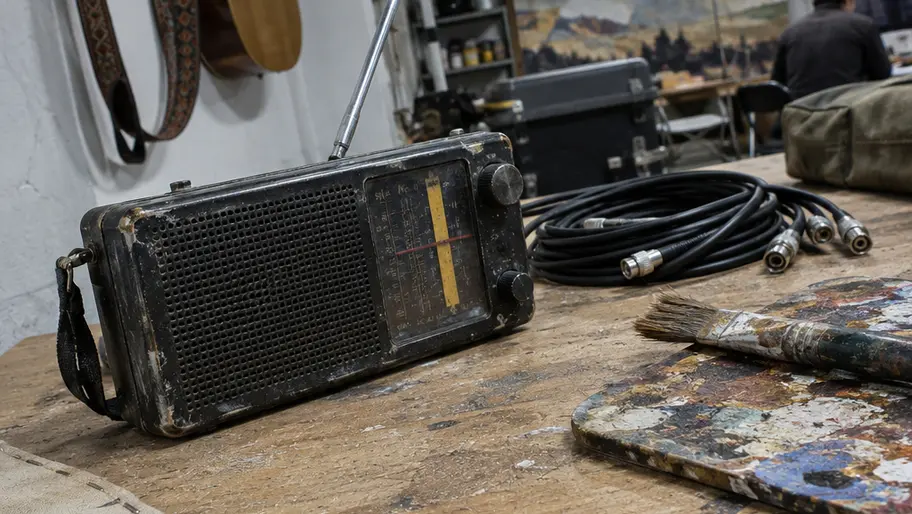
The coordinator turns the dial slowly through dense white noise. Wind presses against a jacket sleeve. Beneath it, the capsule’s recurring modular heartbeat emerges: faint, uneven, recognisable from the cue sheet. The hand stops on the dial.