Broadcasting Into the Void: The Ultimate Sonic Hook
I treat the 2014 Galloway Forest broadcast first as a curatorial choice. The team decided non-reception formed part of the piece itself. That decision set the entire project apart from any standard release or installation.
The event ran for a single 24-hour window. No repeat loops, no gallery queue, no ticket desk. Listeners needed an FM receiver and the willingness to stand inside the signal footprint. Galloway Forest Park had carried Dark Sky Park status since 2009, which already marked the site as remote and radio-quiet.
Engineering the 24-Hour Forest Transmission
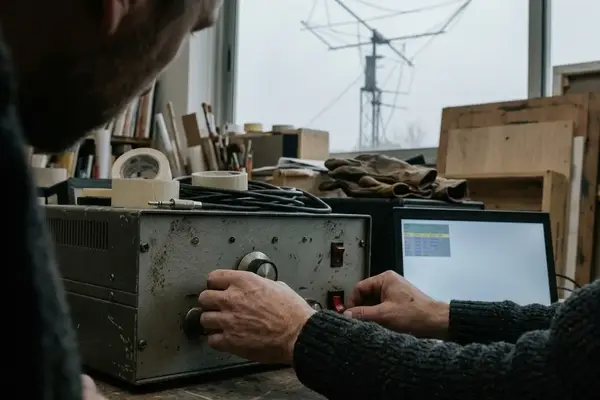
Power budgeting came first. The transmitter, playback device, mixer, monitoring receiver and reserve charging all drew from the same off-grid supply. Every connector in the chain sat exposed to damp woodland conditions, so each joint became a potential failure point.
Signal path stayed simple: playback device to level control, level control to transmitter input, transmitter to feedline, feedline to aerial. The FM band sat in the VHF range, 87.5–108 MHz. I walked the site with a portable receiver rather than trusting the transmitter meters alone, because the artwork existed at the point of reception.
Reviewing the Unheard Catalog
Tracks arrived already sequenced for a day-night-dawn cycle. Dense ambient and low-motion electronic pieces were chosen because wind, rain on needles and receiver hiss could merge with the material instead of competing against it. Submitting work meant accepting that the track might transmit without any confirmed human listener hearing it in full.
The catalog functioned as a sealed offering. Artists released material into a place where applause, analytics and instant feedback stayed absent by design.
Scope and Limitations: Signal Decay in Dense Woodlands
VHF FM travels cleanly in open air. Dense conifer stands introduce foliage absorption, scattering and multipath reflections. Wet biomass increases signal loss further, so reception becomes more variable after rain. Valleys, forest roads and clearings only metres apart on foot produced noticeably different results.
These constraints were not edited out of the work. The forest itself acted as receiver; trunks, wet needles and terrain folds shaped what reached any given point. The same low-power setup behaves differently in a pine plantation than on a hilltop clearing because moisture, canopy density and ground conditions all change the audible edge.
Legacy and Practical Lessons for Sound Artists
The lasting method treats transmission, access and disappearance as compositional materials. Permissions and spectrum questions now open roughly 8–12 weeks ahead, based on the creative process. A dry run a couple of days before the window checks battery behaviour, connector noise, antenna placement and receiver coverage under near-real conditions.
Post-broadcast recovery removes aerial supports, batteries, weatherproof boxes and temporary cable runs so the work leaves no material residue. In a hyper-recorded age the decision to design for disappearance remains the clearest statement the project made.